A month of LinkedIn posts, planned from your own work
Four themed weeks, one buyer problem each, built from material you already have. A worked week, and what the month takes by hand.

Published 8 min read
On this page (8)
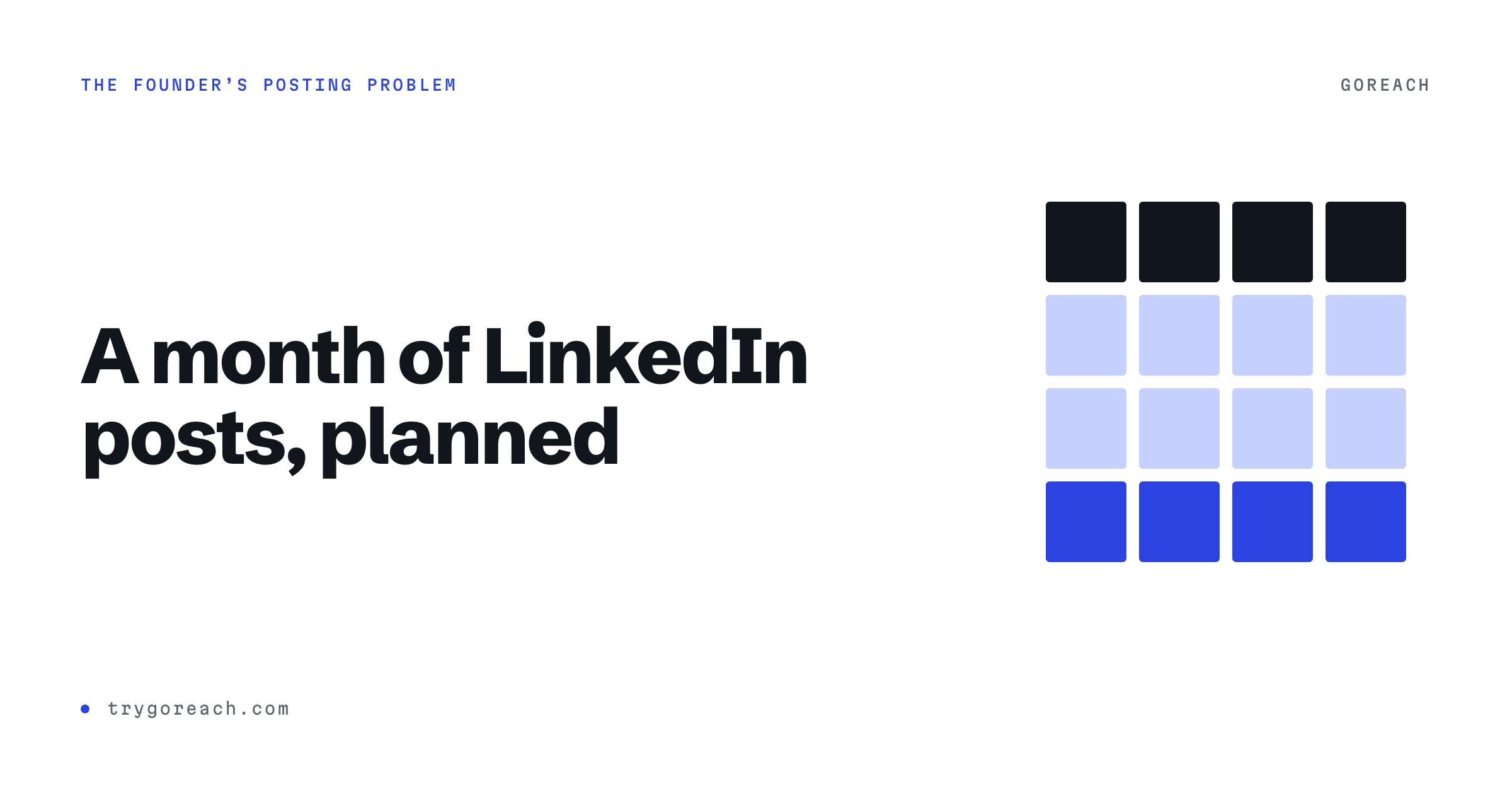
A good LinkedIn content calendar for founders runs in four themed weeks, each built around one buyer problem told in order: the problem, how it gets solved, the person behind it, and an invitation to talk. By hand, that is around fifteen hours a month at three posts a week, by my estimate. GoReach Autopilot plans the month and writes the posts for you to approve.
The estimate is simple arithmetic: a couple of hours to plan, then about an hour for each of thirteen posts. I have not seen good data on how long it takes founders in practice, and I suspect the honest answer for most is "it doesn't happen". This piece is how I think the month should be built, whoever builds it.
What should a LinkedIn content calendar for founders look like?
Most founders who try to post regularly keep a list of ideas. By Tuesday morning the list is either empty or full of topics nobody would stop for, and the post does not happen.
A month planned in themed weeks fixes that, because every slot already knows what it is for. Each week tells one buyer problem in order:
- The problem. A situation the reader recognises from their own week.
- How it gets solved. Something genuinely useful, given away.
- The person behind it. Who you are, and a plain reason to talk to you.
A reader who sees one of the three still gets something. A reader who sees all three has followed an argument, and that is the reader who sends a message.
I prefer this to the common advice of rotating content types (a tip on Monday, a story on Wednesday, a poll on Friday). Rotation keeps the feed varied. It does not tell anyone what you are for.
Autopilot plans each month in exactly these themed weeks, drawn from the strategy it rests on.
Where a month of LinkedIn post ideas actually comes from
Founders have far more material than they think, scattered across places nobody calls content: product pages and case studies on the website, proposals and pitch decks, the questions buyers ask on calls, support questions that keep coming back, past posts, talks and voice notes. The way you explain the problem when money is on the line is usually your clearest writing.
Pulling it together by hand is an evening's work. Turning it into facts a post can rest on is another, because each fact should be quoted in the exact words of its source. That is what keeps a post from drifting into a claim you never made.
GoReach does this part for you. Autopilot reads your website, what the web says about you, and any documents, images or voice notes you add. It draws out facts with the exact words they came from, asks you to confirm them, and uses only confirmed facts in posts. When two sources disagree, it asks which is right. It never reads LinkedIn pages.
One week, worked through
Here is a week for an invented bookkeeping firm that serves dental practices. The buyer problem is a practice owner who cannot tell whether a new hire is paying for herself.
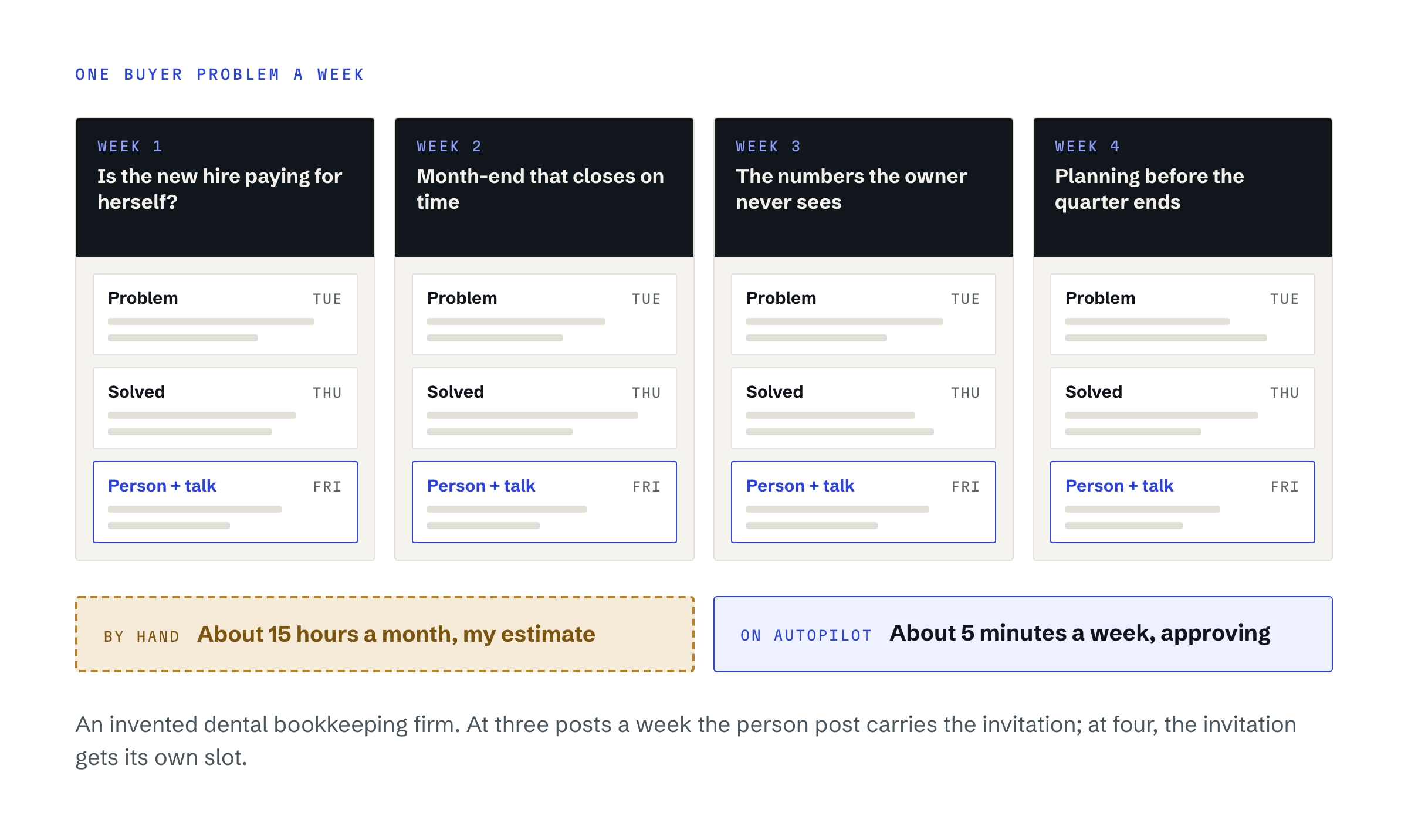
- Tuesday, the problem. An owner who hired a second hygienist and still cannot say, six months later, whether she is paying for herself. Told as a scene from an anonymised conversation.
- Thursday, how it is solved. The three numbers that answer the question each month, and where each one comes from in the practice's own system, as a document carousel.
- Friday, the person and an invitation. Why the founder started tracking this for clients, ending on one plain line: if you own a practice and cannot answer this, send a message and we will look at your numbers together.
At four posts a week, the person and the invitation each get their own post. At three, the person post carries the invitation.
GoReach writes each of these in your voice and picks the format the post calls for: an image card, or a document carousel of four to eight slides drawn from the post itself. It refuses any slide that states something the post does not.
When a post needs something you have not given it
Some slots need material that is not in the pile: a client result, a recent story, a number nobody has checked. This is where most calendars fill up with filler. Or worse, with an invented example that reads well and is not true.
I feel strongly about this one. A made-up result in a founder's post is a liability the first time a buyer asks about it.
So GoReach turns the gap into one short question to you that week, answerable out loud in a couple of minutes. Something like: "Which client this month made you change how you work, and what did they say?" Your answer, typed or spoken, becomes the material. If the answer is not there, the slot gets a different post. A result is never made up.
When each post goes out
Two to four posts a week, at least a day apart, in your buyers' working hours and in their time zone, with their public holidays and quiet weeks left light. If a business moment falls in the month, such as a quarter end or your buyers' budget season, the week whose problem fits it goes there.
There is more on when each post goes out, and on why two to four posts a week is the range.
Autopilot sets the slots for the markets you sell to, main market first, avoids their public holidays and quiet weeks, and times posts to business moments where they fit. Approved posts are scheduled for their planned time.
Written ahead, and edited before you see it
The expensive part of a post is starting it, which we worked through in the hour a post takes. A month planned in advance removes the blank page. Writing ahead removes the Tuesday-morning panic.
GoReach writes each post due in the next eight days from your confirmed facts, then runs an editor over it. The editor applies the reach checklist and the list of AI tells, catches any number found nowhere in your facts or anything on your never-say list, and reads the hook, vague claims, tone and any invented anecdote. It revises up to twice and keeps the best version. A draft that still has notes is shown to you with them. Each post arrives with a first comment.
What stays yours, and how it is published
You approve the month's plan, then each post, or the whole week at once, in the app or on WhatsApp with Approve, Change or Skip. Nothing publishes without that.
Approved posts go out through LinkedIn's official API, with the permission you grant on LinkedIn's consent screen. GoReach never logs in as you. It does no scraping, and it sends no automated likes, comments, connection requests or DMs. The first comment is handed to you to paste. It is built to stay within LinkedIn's rules, which in my view makes it the lowest-risk way to automate your LinkedIn, and no tool can promise how LinkedIn treats an account.
Autopilot does the month for $199 a month or $1,990 a year, in US dollars. It is designed around about fifteen minutes to set up and about five minutes a week after that. Those are design figures; I have no customer measurements to put behind them yet. There is no free plan and no free trial; ask within 14 days of your first payment and we refund what we received. Payment processing fees are not returned.
Questions founders ask
How many LinkedIn posts should a founder plan per month?
At two to four posts a week, between eight and seventeen. Three a week, about thirteen a month, is the default Autopilot plans for a founder who also runs a company. It recommends two when the goal is investors or hiring, or when there is little to write from yet.
Can I get a LinkedIn content plan done for me?
Yes. A ghostwriter or an agency can do it, usually on a retainer. GoReach Autopilot plans each month from your own material and writes every post in your voice for you to approve, for $199 a month.
What should I post on LinkedIn as a founder when I have nothing to say?
You almost certainly have material in your website, your proposals and your sales calls. Pick one problem your buyers have and tell it in three posts: the problem, how it is solved, and who you are. Where a post needs a story only you have, Autopilot asks one short question that week instead of guessing.
Is it safe to schedule LinkedIn posts with a tool?
Scheduling through LinkedIn's official API, with your permission and your approval on each post, is the low-risk way. Tools that log in as you or automate activity in your browser are what LinkedIn restricts.
Can I reuse the same buyer problem in next month's plan?
Yes, from a different angle. Returning to a handful of buyer problems is how readers learn what you are about. Autopilot plans each month fresh from your research and your confirmed facts.