The founder's posting problem6 min read
The hour you do not have
A post worth publishing takes about an hour, and the hour has to come from somewhere. Where it actually goes, what the alternatives charge to take it off you, and the three things that genuinely shorten it.
By Neeraj · Updated
Most founders know that posting on LinkedIn would bring them work. Most founders do not post. The gap between those two facts is not laziness and it is not a content calendar.
It is that a post worth publishing takes about an hour, and the hour has to come from somewhere.
Where the hour actually goes
Almost none of it is typing. The time goes on deciding what to write about, remembering the specifics that make it worth reading, working out the opening, and then the part nobody budgets for: reading it back and deciding it is not good enough to put your name on.
That last step is where most drafts die. Not at the blank page, at the second read.
The second read, which is where drafts die
The blank page gets all the attention and it is not the expensive part. The expensive part is the moment twenty minutes later when you read the finished thing back and it sounds like somebody else wrote it.
That reaction is usually correct, and quality is rarely the reason. The draft is competent and it does not sound like you, because writing something you intend to publish under your own name pulls everybody toward a flatter, more careful register than the one they talk in. So the draft gets shelved, which feels like good judgement and costs you the whole hour anyway.
The fix that works is to stop writing from scratch and start from something that is already yours. Dictate the story to a colleague, or answer a direct question about it, and then edit the transcript. What comes out is unpolished and it is recognisably you, and editing is a far smaller job than drafting. That is also the mechanism behind voice profiles in GoReach: a draft shaped by posts you have already published does not trigger the "this is not me" reaction, so the second read stays a read.
What the alternatives cost
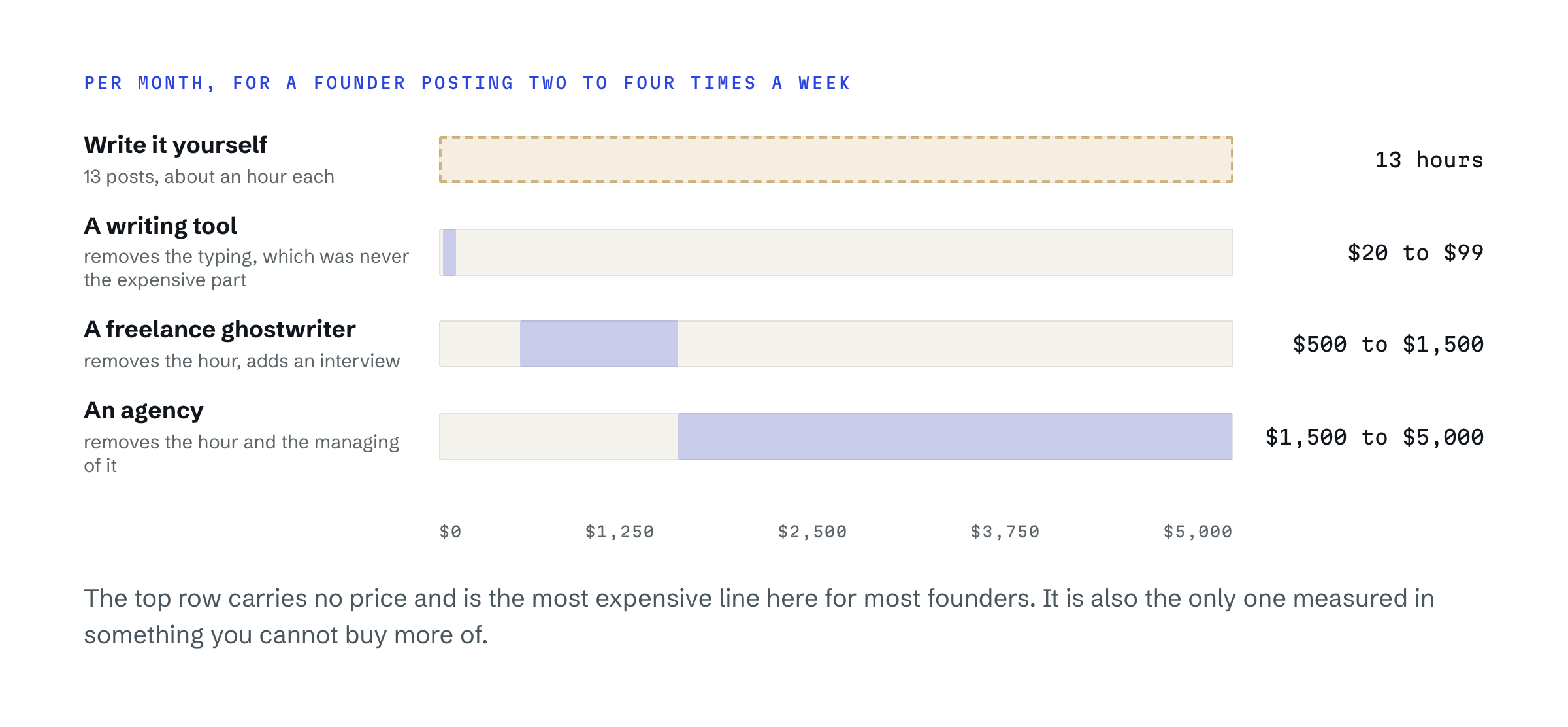
The market has priced this problem, and the prices are a useful way to see what people believe the hour is worth.
Writing tools run roughly $20 to $99 a month. They remove the typing, which was never the expensive part.
A freelance ghostwriter is $500 to $1,500 a month. They remove the hour, and they need interviewing, which is a smaller hour you now owe them.
An agency is $1,500 to $5,000 a month. They remove the hour and the management of it.
The spread tells you something. People are not paying to have words produced, which is nearly free now. They are paying for the judgement about what is worth saying, and for somebody else to carry the second read.
The trap in the cheap option
The obvious move is to have a chatbot write it. It takes nine seconds and costs nothing, and it fails in a specific way: the output reads as machine-written, the feed has learned what that looks like, and the post gets less distribution than if you had written three worse sentences yourself.
So the tool that saved the hour also wasted the effort. You spent nothing and got nothing, and the account now has a post on it that does not sound like you.
What actually reduces the hour
Three things, in order of how much time they give back.
Not starting from a blank page. Deciding what to write about is the most expensive step. Answering a specific question about something that happened last week is a different and much smaller task than choosing a topic.
Writing in a voice that is already yours. Most of the second read is spent recognising that the draft does not sound like you. A draft shaped by things you have already published does not trigger that, so the read is a read rather than a rewrite.
Knowing before you post whether it will travel. The uncertainty is its own cost. Checking a draft against a fixed list, rather than guessing, turns the last ten minutes from worrying into fixing.
The arithmetic nobody does
Three posts a week is thirteen a month. At an hour each that is thirteen hours, which for a founder billing anything at all is the most expensive line in the comparison above by a wide margin. The cheapest option on the list is almost always the one that removes the most minutes, not the one with the smallest monthly number.
It is also the reason the "just write it yourself, it only takes twenty minutes" advice fails in practice. It does take twenty minutes, for the person who already knows what they are going to say. The hour is what it costs when you do not, and the founder who does not post is by definition in the second group.
What you are actually buying
Every option on that list sells the same thing in a different wrapper: somebody else carrying the part of the hour you cannot delegate to a blank page.
A ghostwriter carries it by interviewing you, which is why the good ones are expensive and the cheap ones produce posts that could have been written about anyone. What they are extracting in that interview is the specific thing that happened in your week, because that is the only raw material that makes a post worth reading.
A tool can carry the same part, if it asks the same question. That is the whole design of the weekly interview in GoReach: one question, answerable out loud in two minutes, written to produce a scene rather than a summary. The cadence piece covers what to do with the answers and why two to four a week is the target.
The honest version of the pitch
None of this makes posting free. It makes it about fifteen minutes instead of an hour, which is the difference between twice a week and never.
If you are posting consistently already and it is working, you do not have this problem and you should ignore all of it. This is written for the founder with eleven drafts in their notes app and nothing published since March.