The founder's posting problem6 min read
Posting cadence for founders: why two to four a week
Most cadence advice gives you a number with no reasoning behind it. Here is the case for two to four posts a week, including why four is a ceiling rather than a target.
By Neeraj · Updated
The honest answer to "how often should I post on LinkedIn" is a range, and most advice gives you a number instead. Daily, say the growth accounts. Three times a week, say the agencies. Whatever you can sustain, say the people who do not want to be wrong.
GoReach targets two to four posts a week, and the dashboard treats four as a ceiling rather than a goal. Here is the reasoning, because a target without one is just another number to feel bad about.
Why the floor is two
One post a week does not compound. A reader who sees you once in seven days has no reason to remember your name by the time you appear again, so every post starts from zero and has to earn attention on its own merits. Two is the point where the second post lands while the first is still faintly in memory, and the two become a position rather than two opinions.
There is a mechanical argument too. Reach on any single post is volatile: the same quality of writing can get 400 impressions one week and 4,000 the next, depending on who happened to be in the feed. At one post a week you cannot tell signal from noise for months. At two or three you have enough samples in a quarter to see which topics actually travel for you.
Why the ceiling is four
This is the half that most advice leaves out, and it is the half that protects the work.
A founder has about as much genuinely new material in a week as the week produced. Posting daily from a week that contained two real events means five posts of filler, and filler is exactly what gets demoted: no specifics, no numbers, nothing a camera in the room would have recorded. The platform's distribution rests on dwell time, so a post nobody finishes is worse than no post at all, and a run of them teaches the feed that your name is not worth stopping for.
Four a week is roughly the upper limit at which a founder can still write from something that actually happened. Past that you are writing to a schedule, and it reads like it.
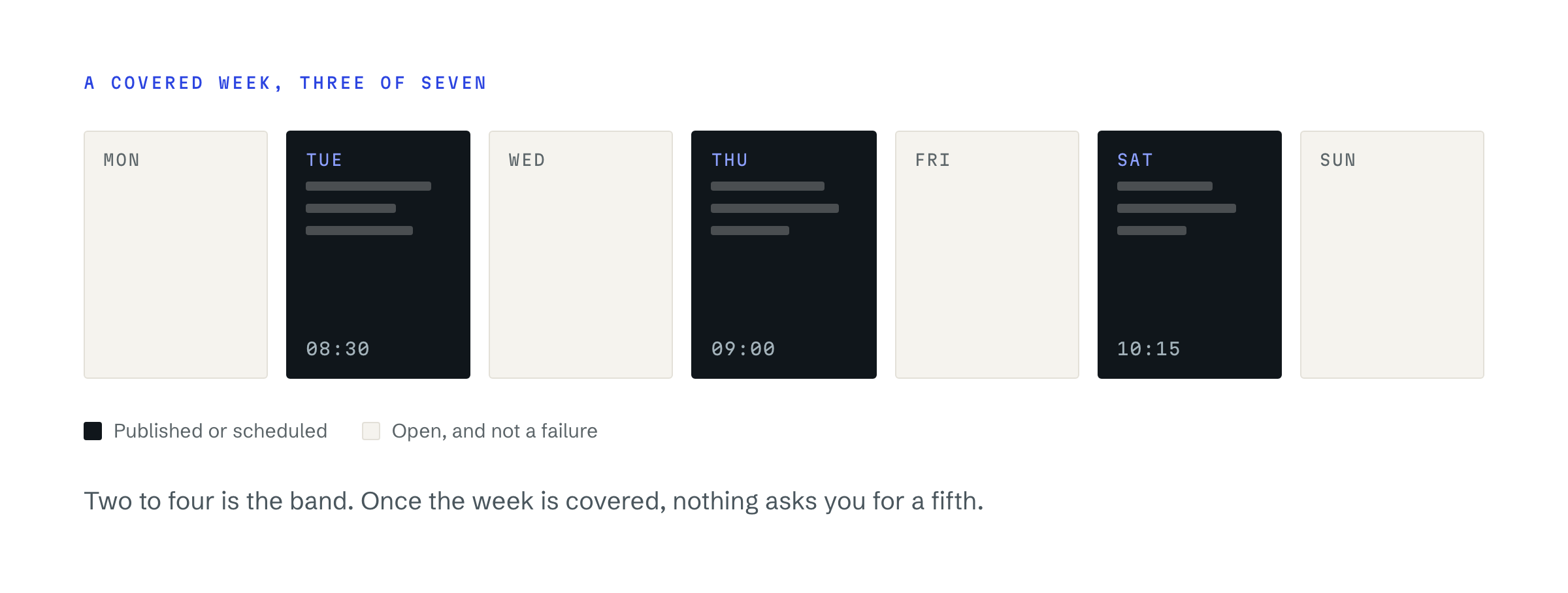
So the dashboard counts a week as covered once published plus scheduled reaches the target, and then stops asking. Nothing in the product nudges you toward a fifth post. That was a deliberate decision: a tool that always wants more is optimising for its own engagement rather than your reach.
What the numbers look like over a month
At three posts a week you publish about thirteen pieces a month. That is enough for two or three to land properly, which is the realistic shape of it: most posts do their job quietly and a small number do the work. It is also roughly fifteen posts in a 30-day window, which is why the GoReach trial is 30 days rather than a fortnight. Two weeks buys around six posts, which shows you a tool. A month buys fifteen, which shows you whether posting works for your business.
Thirteen posts a month is also, at an hour a post, thirteen hours. That is the real reason cadence advice fails: the number is achievable and the hours are not. The piece on the hour you do not have covers where that hour goes and what the alternatives cost.
The empty week, which is the actual problem
Nobody fails at cadence because they cannot type. They fail because on Tuesday morning there is nothing to say, and the honest response to nothing to say is not to post.
The method that works, and the one professional ghostwriters have always used, is an interview. Not a content calendar, not a swipe file: a question that makes you remember something specific that happened. "What did you change your mind about this month?" produces a post. "Write about leadership" does not.
GoReach asks one such question a week and turns the answer into material. The questions are written to be answerable out loud, from memory, in two minutes, and they deliberately avoid abstractions like "a decision" or "a lesson", because those invite a summary rather than a scene. A week's worth of posting usually comes from one honest answer about something that actually happened at work.
Two to four of what
Cadence without a mix produces a feed of one note. The split that holds up for a founder is roughly: one post that tells a story from the week, one that takes a position, and anything beyond that spent on something practical the reader can use.
The story post is the one only you can write, and it is the one that builds the audience. The position post is what gets quoted back at you in a sales call six months later. The practical post is the one that gets saved and shared, and it is also the easiest to write badly, because advice with no specifics is the most common form of filler.
A useful filter for all three: would a camera in the room have recorded this. "We changed our onboarding" passes. "Leadership is about listening" does not. The posts that travel are almost always the ones with something in them that could only have come from your week.
Topic consistency matters more than people expect as well. Three or four recurring subjects give a reader a reason to follow you rather than to like one post and leave. GoReach files every post under one of your topics for exactly this reason, so you can see at a glance whether you have written about the same thing six times or about six different things once.
A cadence you can hold through a bad month
Pick the number you can hit in your worst week, not your best one. If that is two, post twice. A steady two beats a heroic five followed by three weeks of silence, because the silence undoes the compounding that made the five worth writing.
Three practical rules that survive a bad month:
- Write when you have material, publish on a schedule. Drafting and publishing do not have to happen on the same day, and scheduling is what turns a good Sunday into three good weekdays.
- Capture during the week, not on posting day. The specifics that make a post worth reading are forgotten within about a day of the thing happening.
- Never post to keep a streak. The streak is a metric you invented. The reader has no idea it exists.
If you want the week laid out for you, GoReach's dashboard is built around exactly this: seven slots, a target of two to four, and an empty slot as the only thing it ever asks you to fill. It stops asking once the week is covered.