Best time to post on LinkedIn, for founders
The timing studies disagree on the hour and agree on the shape. For a founder, the best time is your buyers' working hours, in their time zone, kept off their holidays.

Published 9 min read
On this page (8)
The best time to post on LinkedIn, for a founder selling to other businesses, is a weekday slot in your buyers' working hours, in their time zone, with posts at least a day apart and their public holidays left empty. The large studies agree on weekdays, especially Tuesday to Thursday, and disagree on the hour. So treat any exact time as a starting point to test.
Working that out for your market is the easy part. Checking it against another country's calendar every month, and being at a keyboard when the slot arrives, is the part founders drop within weeks. GoReach Autopilot sets the slots from where your audience is and schedules each post you approve through LinkedIn's official API, so it goes out on your buyers' clock while you are asleep or with a client.
How often to post is a separate question, and I covered it in how often to post. This piece is only about when.
What do the studies say about the best time to post on LinkedIn?
They say different things, and it helps to see exactly how different. Here are two of the best-known, both checked on 15 November 2026.
- Sprout Social, in its 2026 study, looked at 2 billion engagements across 307,000 profiles between 27 November 2025 and 27 February 2026. It says Tuesday, Wednesday and Thursday have the most consistent peaks, with windows running from late morning into the afternoon, for example Tuesday 11am to 5pm in local time. It calls Saturday and Sunday the worst days.
- Hootsuite, in its LinkedIn timing post, analysed over a million posts and gives 8am to 9am on Tuesdays and Wednesdays as the best overall time for 2025. Its own body text, on the same page, also points to early morning, 4am to 6am.
One study says late morning to afternoon. The other says breakfast, or before it. Neither is wrong. They measure different accounts in different industries over different periods, and they count engagement in different ways. An average across millions of posts tells you when LinkedIn is busy in general.
It cannot tell you when the twelve operations directors you want to reach open the app. I have not seen good public data on that for any specific audience, and I doubt it exists. So I will not give you a magic hour.
What the studies do share is a shape: weekdays, the middle of the week, working hours. That shape is where GoReach's playbook starts. Its posting windows sit mostly from Tuesday to Thursday, mid-morning into lunch, in your audience's own time, and the playbook says in as many words that timing matters less than topic and format. I agree with it.
Whose clock? Post in your buyers' time zone
The most common timing mistake founders make is posting on their own schedule.
If you are in London and your buyers are on the US East Coast, a post at 9am your time lands at 4am theirs. By the time they wake up it has been in the feed for hours, and the first people to see it were outside your market.
Three cases cover most founders. With buyers in one region, the slots sit in their working hours. With two regions that overlap, the overlap wins: London and New York share a window in the London afternoon, which is the New York morning. With buyers spread widely, the region with most of them sets the schedule.
Autopilot times your posts for the markets you sell to, whatever your own time zone is, and schedules each approved post into those slots. Your main market comes first. Markets whose working days overlap, such as the US and the UK, share one time, so one post reaches both. Markets too far apart for that, such as the US and India, take turns, each on its own working mornings. If you sell worldwide, posts go out on weekday mornings in New York, which is the afternoon in Europe. You can correct your markets in the Library, beside what the research found and where it found it.
The best days to post on LinkedIn for B2B
Most B2B buyers read LinkedIn on working days, which is the one point both studies above agree on. Role matters inside that. A clinic owner who sees patients all morning reads at a different time from a software engineer, and you know your buyers' day better than any study does.
Two rules hold whatever the role. Weekdays reach more working buyers than weekends. And posts should sit at least a day apart, because two posts on the same day compete for the same readers.
The Autopilot playbook schedules two to four posts a week, three by default and two when your goal is investors or hiring, at least a day apart, in weekday windows. You never have to space them by hand.
The calendar beyond the week
Timing is also about the month and the year, and this is where founders lose the most posts without noticing.
A post aimed at US buyers on a US public holiday reaches fewer of them. Late December is quiet in most B2B markets, and so is much of August in large parts of Europe. Some moments work the other way: the end of a quarter, budget season, the start of a financial year. If your buyers set budgets in the autumn, that is when a post about the cost of a problem lands.
Checking all of that every month, for your buyers' country and not yours, is exactly the kind of small recurring job that slips.
Autopilot keeps posting days off the public holidays and quiet weeks where your buyers are. A post can also be timed to a business moment, such as a quarter end or budget season, when it fits that week's theme in the month plan.
A worked example of a LinkedIn posting schedule
Take an invented founder in Manchester who sells software to finance teams at mid-sized US companies, mostly on the East Coast.
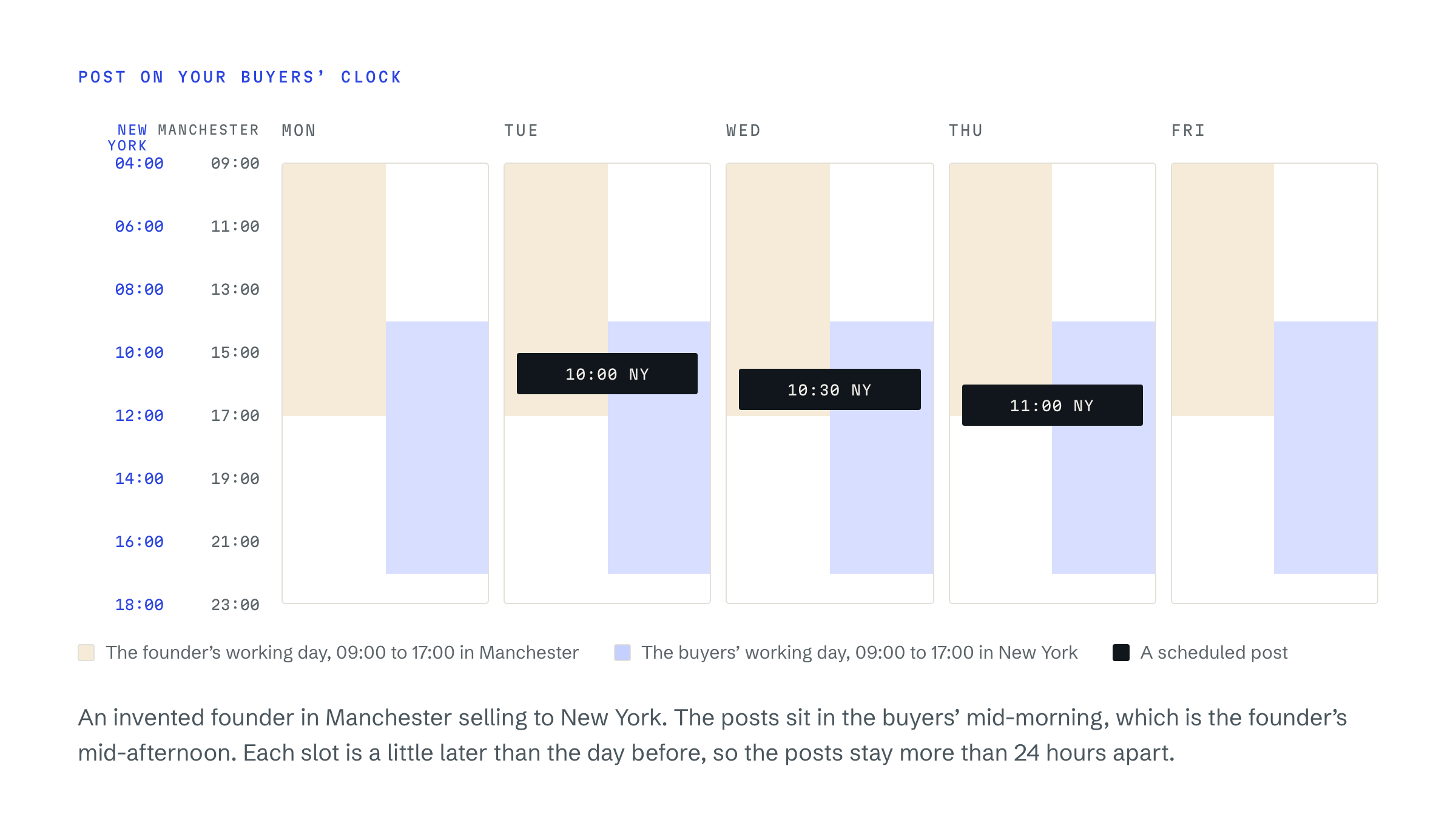
The buyers are on New York time, so the slots sit in their mid-morning, which is mid-afternoon in Manchester. Three posts a week go out on Tuesday, Wednesday and Thursday. Each slot is a little later than the one before, so every post lands more than 24 hours after the last. US public holidays stay empty, and late December is light. A post about quarter-end close is timed for the end of the quarter, when these buyers feel that problem.
Set up by hand, that is a spreadsheet, a holiday calendar for another country and a recurring reminder. On Autopilot it is planned for you each month, and you can read and change any of it.
How to find the best time for your own audience
Timing is worth testing, slowly. Hold the same slots for a month before changing anything, and change one thing at a time. Judge by who responds as well as by how many.
Reach on a single post varies a great deal for reasons that have nothing to do with timing, so one good Thursday proves nothing. A month of Thursdays starts to say something.
On Autopilot, the weekly report is built from the leads you record and the post numbers read from your screenshots, so you can see which days brought replies from the right people without keeping the log yourself.
Is it safe to schedule LinkedIn posts with a tool?
The timing advice above only helps if the post actually goes out in the slot. That is where most founders reach for a scheduler, and it is worth knowing how the scheduler posts.
Some tools post, like and comment by running software in your browser or by logging in to your LinkedIn as you. LinkedIn's help page on prohibited software and extensions says it does not permit software that automates activity on its site, and that members using it risk having their accounts restricted or shut down.
GoReach publishes your approved posts through LinkedIn's official API, with the permission you grant when you connect. It never logs in as you. It does no scraping, and it sends no automated likes, comments, connection requests or DMs. When a post goes live, the first comment is handed to you to paste, with an email reminder about ten minutes after it goes live.
It is built to stay within LinkedIn's rules, which I think makes it the lowest-risk way to automate your LinkedIn. No tool can promise how LinkedIn will treat an account. More on automation without risking your account.
On Autopilot, at $199 a month or $1,990 a year, timing is part of a plan that also researches your market, writes every post in your voice and schedules what you approve. Your part is designed around about five minutes a week. It is LinkedIn on Autopilot, with you approving every post. On Pro, at $49 a month or $490 a year, you write each post yourself and schedule it through the same official API.
Questions founders ask
What is the best day to post on LinkedIn?
A weekday when your buyers are working. Sprout Social's 2026 study points to Tuesday through Thursday and Hootsuite's to Tuesday and Wednesday, so the middle of the week is a sensible start. Test it against your own audience over a month.
What is the best time to post on LinkedIn for B2B?
During your buyers' working hours, in their time zone. The published studies disagree on the hour, from early morning to mid-afternoon, so pick a slot that suits your buyers' day and hold it for a month before judging.
Should I post on LinkedIn at weekends?
Usually not for B2B, because fewer working buyers are reading, and Sprout Social's data ranks Saturday and Sunday lowest. If your buyers are owners who work weekends, it can be worth a test.
Is it safe to schedule LinkedIn posts with a tool?
It depends on how the tool posts. A tool that publishes through LinkedIn's official API with your permission, as GoReach does, stays clear of the browser automation LinkedIn restricts. Ask any scheduler whether it logs in as you or runs inside your browser.
Does posting time matter more than frequency?
Consistency matters more. A steady two or three posts a week at reasonable times will do better over a quarter than perfect timing once a fortnight.