Is LinkedIn automation safe? What LinkedIn actually restricts
LinkedIn restricts tools that scrape, run in your browser or act as you. Here is what its own pages say, and why the official API is the lowest-risk way to automate.

Published 10 min read
On this page (8)
Is LinkedIn automation safe? It depends entirely on the method. LinkedIn's own help pages say it does not permit third-party software or browser extensions that scrape its site or automate activity on it, and that members who use them risk having their accounts restricted or shut down. Publishing posts you approved through LinkedIn's official API, with your permission, is a different method.
That second method is the one GoReach uses. It automates the research, writing and scheduling of your posts, never logs in as you, and is built to stay within LinkedIn's rules.
I will be straight about the limit of that. No tool can promise how LinkedIn treats an account, and anyone who does is promising something only LinkedIn controls. What you can do is pick a method that avoids the behaviour LinkedIn's rules are written against. This piece is about what that behaviour is, in LinkedIn's own words.
Is LinkedIn automation safe? Why founders ask
Most founders who look at LinkedIn tools want one thing: their hours back. A good post takes about an hour once you count deciding what to say, finding the specifics and the second read. At three posts a week that is around thirteen hours a month, before replies and planning.
Automation promises to take that away. The worry is the price.
A founder's profile is often the first thing a buyer, an investor or a candidate looks at. Losing access to it for a week, or for good, would cost far more than the hours saved. So the useful question is a narrower one: which kinds of automation does LinkedIn restrict, and which kind does the tool in front of you use?
What LinkedIn says it prohibits
When we were deciding how GoReach would publish, I read LinkedIn's rules closely. They are spread across four pages. Here is what each one says.
The help page on prohibited software. LinkedIn's page on prohibited software and extensions says it does not permit "any third party software, including 'crawlers', bots, browser plug-ins, or browser extensions" that "scrape, modify the appearance of, or automate activity on LinkedIn's website." Members who use them are in breach of the User Agreement and, in the page's words, "risk having their accounts restricted or shut down."
The User Agreement. Section 8.2 of the User Agreement is the list of things members agree not to do. Two items matter here. One prohibits using software, scripts or robots to "scrape or copy the Services, including profiles and other data from the Services". Another prohibits using "bots or other unauthorized automated methods to access the Services, add or download contacts, send or redirect messages, create, comment on, like, share, or re-share posts, or otherwise drive inauthentic engagement".
The Professional Community Policies. LinkedIn's Professional Community Policies say: "Don't do things to artificially increase engagement with your content." They also ask members not to "agree with others ahead of time to like or re-share each other's content", which is what an engagement pod is.
The help page on automated activity. LinkedIn's page on automated activity repeats that it does not allow third-party software or browser extensions that scrape data or automate activity on its site. For an account that has been restricted, its first instruction is to review and disable that software.
Read together, the rules are about how a tool reaches LinkedIn and what it does once it is there. The behaviours named are scraping, software running on LinkedIn's website, and automated actions that stand in for you clicking: likes, comments, shares, connection requests, messages.
The word I paid most attention to was "unauthorized" in that second User Agreement item. LinkedIn does offer apps an authorised route to post for a member: its official API, which members grant permission to on LinkedIn's own consent screen.
Does LinkedIn ban automation tools? It depends which of three kinds
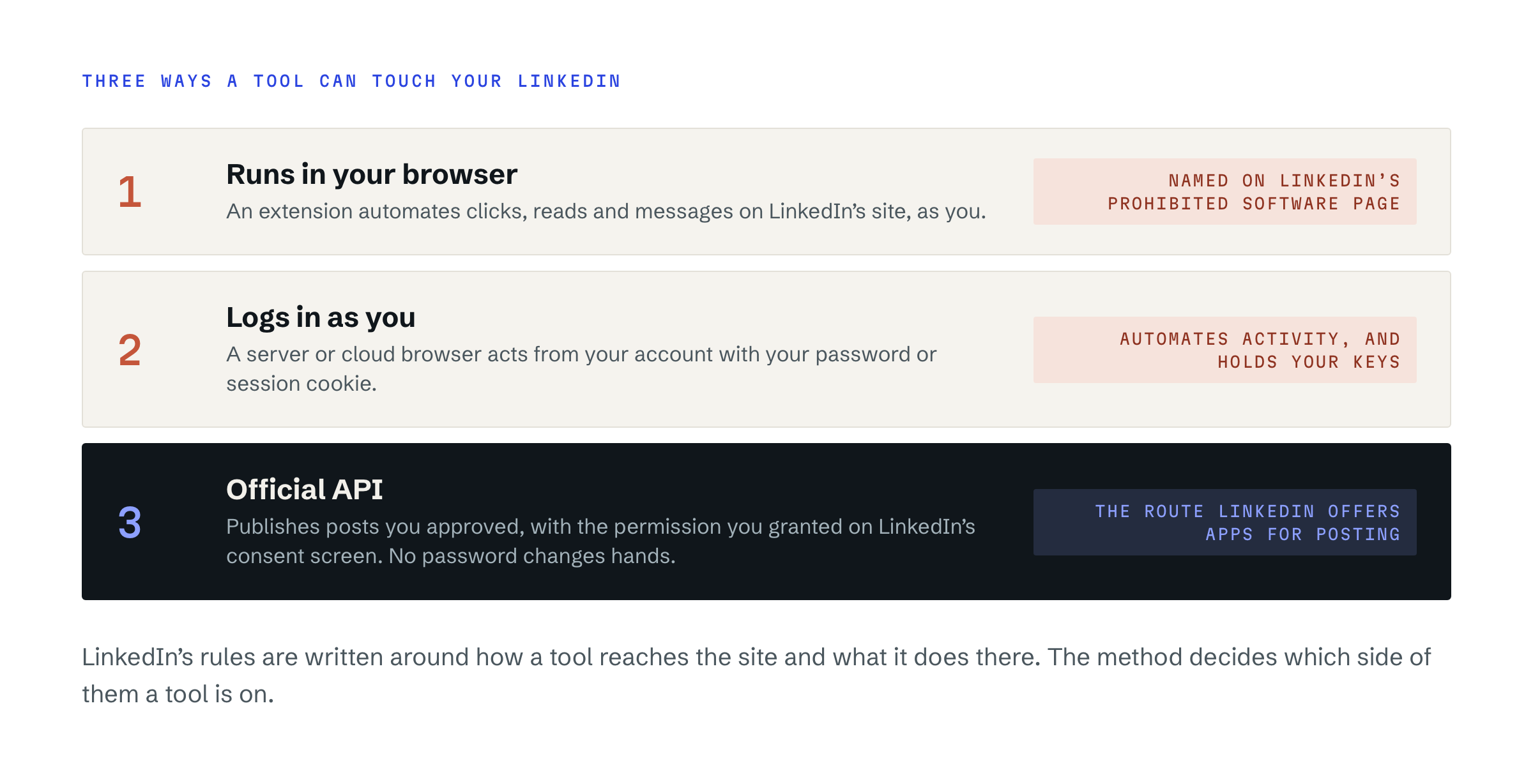
Broadly, every LinkedIn tool works in one of three ways. The way matters far more than the brand.
1. Software in your browser
A browser extension sits inside your LinkedIn session. It can read pages as you load them, click buttons, send messages and visit profiles, all as you. This is the category LinkedIn's prohibited software page describes most directly: browser plug-ins and extensions that scrape or automate activity on its website.
2. A server that logs in as you
Some tools ask for your LinkedIn email and password, or a session cookie, and run your account from their own servers or a cloud browser. To LinkedIn, the activity comes from your account with nobody at the keyboard. And handing over a password means a third party now holds the keys to your profile, which is a risk of its own whatever LinkedIn thinks of it.
3. LinkedIn's official API, with your permission
LinkedIn offers an API for apps to publish on a member's behalf. You connect through LinkedIn's own consent screen, see what the app is asking for, and approve it. The app receives a permission token for that purpose and never sees your password.
That is the method I chose for GoReach, and the reason is simple: it is the route LinkedIn built for this job.
What LinkedIn's rules say about AI-written posts
There is one more page worth knowing about if the tool writes with AI. LinkedIn's Developer AI Policy, its rules for developers building AI features on its marketing APIs, tells developers to restrict automated posting of AI-generated content to LinkedIn without the user's involvement. Where generated content will be published under the user's name, the user should be given tools to edit it first.
I think that is right on its own merits, quite apart from the policy. Your name is on every post. A tool that publishes AI text you never saw is asking you to trust it with your reputation, and I would not.
Where GoReach sits
GoReach uses the third method only. These are facts about how it is built, checked against its code:
- It publishes through LinkedIn's official Posts API, with the permission you grant on LinkedIn's consent screen. It asks for your basic profile and the right to post on your behalf, nothing more.
- It never logs in as you and never sees or stores your LinkedIn password. Signing in to GoReach is separate, with Google or a password of its own. The LinkedIn token it holds is encrypted at rest, and you can disconnect LinkedIn from GoReach at any time.
- There is no browser extension. Nothing runs inside your LinkedIn session.
- It does no scraping. Its research reads your website and the open web, and its crawler refuses LinkedIn addresses outright.
- It sends no automated likes, comments, connection requests or messages, and joins no engagement pods.
- Nothing publishes without your approval. You approve each post, or the week's ready posts at once, in the app or on WhatsApp.
- The first comment is handed to you to paste. Posting a comment for you needs a LinkedIn permission GoReach does not hold, so it gives you the text with one-press copy and an email reminder about ten minutes after the post goes live. More on why you paste the first comment.
That is why I describe GoReach as built to stay within LinkedIn's rules, and as the lowest-risk way to automate your LinkedIn. It is a description of the method. GoReach is not endorsed by LinkedIn, and no tool can promise how LinkedIn treats an account.
What safe automation gives you back
The point of all this is time. On Autopilot, GoReach does the hours a founder usually cannot find. It researches your business and up to four competitors, proposes your positioning and a strategy, plans each month, and writes every post in your voice from confirmed facts, each with a first comment and an image card or carousel.
Your part is designed around about fifteen minutes to set up and about five minutes a week to approve. Autopilot is $199 a month or $1,990 a year, in US dollars.
If you would rather write your own posts and want voice-matched drafts, a reach grade with fixes, and scheduling through the same official API, Pro is $49 a month or $490 a year. There is more on what LinkedIn on Autopilot should mean if you are deciding between the two.
How to check any LinkedIn tool in five minutes
Before you connect a LinkedIn tool, ask it four questions. The answers tell you which of the three methods it uses.
- Does it ask for my LinkedIn password or a session cookie?
- Does it need a browser extension, or run in a cloud browser?
- Does it like, comment, connect or message for me?
- Can anything go out without my approval?
A yes to any of the first three puts it in the territory LinkedIn's help pages warn about. A yes to the fourth puts your name on words you never read. We go through the categories side by side in the three kinds of LinkedIn tool, compared, and through what to automate and what never to.
Questions founders ask
Does LinkedIn ban automation tools?
LinkedIn says it does not permit third-party software or browser extensions that scrape, modify the appearance of, or automate activity on its website, and that members who use them risk having their accounts restricted or shut down. Publishing through LinkedIn's official API, with permission you grant on its consent screen, is a different method built for apps to post on a member's behalf.
What are the risks of LinkedIn automation?
The risks LinkedIn names are account restriction or closure for using software that scrapes or automates activity on its site. Tools that log in with your password add a second risk: a third party holding the keys to your profile. Choosing a tool that uses the official API and never asks for your password avoids both behaviours.
What does LinkedIn count as prohibited software?
Its help page lists crawlers, bots, browser plug-ins and browser extensions that scrape, modify the appearance of, or automate activity on LinkedIn's website. Its User Agreement also prohibits bots or other unauthorized automated methods that add contacts, send messages, or create, comment on, like or share posts.
Does GoReach log in to my LinkedIn account?
No. You connect LinkedIn through LinkedIn's own consent screen, GoReach receives permission to post on your behalf, and it never sees or stores your password. It runs no automated likes, comments, connection requests or messages.
Is posting AI-written content against LinkedIn's rules?
LinkedIn's Developer AI Policy tells developers to restrict automated posting of AI-generated content without the user's involvement and to let the user edit it first. GoReach publishes only the version you approved. If you want to see how a draft holds up before you commit to anything, run it through the free grader, three a day with no signup.