LinkedIn content strategy for B2B founders
A founder's LinkedIn strategy rests on research into buyers and competitors. What a good one contains, and who should build it.

Published 10 min read
On this page (8)
A LinkedIn content strategy for B2B founders settles four things: who you write for, which of their problems you talk about, why you are the one to say it, and how often you post. Each of those rests on research into your buyers' own words and what your competitors already claim. By hand that research is a long afternoon. GoReach Autopilot does it for you.
I build GoReach, so read the rest knowing that. But most of this piece is about what a good strategy contains, which is worth knowing whoever builds yours: you, a strategist, or software.
Why most founder LinkedIn strategies stall by week three
The standard advice is to pick three content pillars and a posting schedule. Founders who follow it end up with pillars like "leadership", "growth" and "lessons from building". Any founder in any market could claim those, which is exactly the problem.
I think the advice skips the step that matters. A pillar only works if it names a problem your buyer actually has and a view you can defend with evidence. You cannot pick that from a blank page. You find it by reading what buyers say and what competitors claim, then looking for the gap between them.
That reading is the part busy founders skip. It is slow, and nothing is due at the end of it.
So the plan stalls, and LinkedIn goes back on the list of things the founder will get to next quarter.
What research does a LinkedIn content strategy need?
Two kinds of reading decide everything that comes after them.
Your buyers' words. The phrases buyers use in first emails, on sales calls and in objections. "My accountant only talks to me in April" is a line a buyer would recognise in a post. "Financial operations efficiency" is a theme nobody has ever stopped scrolling for. Founders carry these phrases around in their heads and almost never write them down.
Your competitors' claims. What up to four competitors say on their homepages, who they serve, what they charge, what proof they show, and what their customers complain about in public reviews. In most B2B markets three of the four say roughly the same thing. That shared claim is the one you should not lead with, however true it is of you.
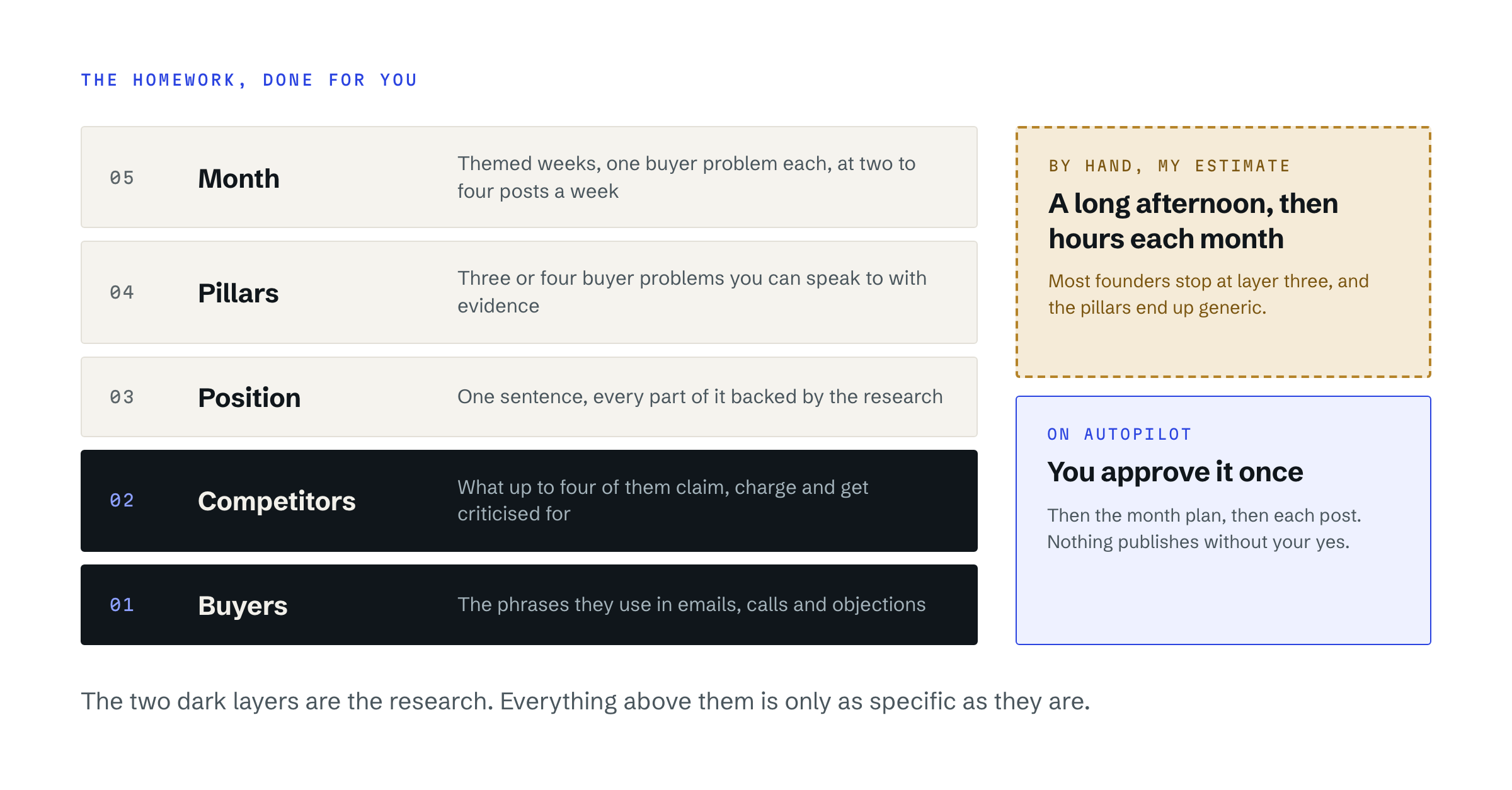
Collecting both by hand is the long afternoon. Keeping it current as competitors rewrite their homepages is a recurring job, and it is the first thing to slip.
This is the part GoReach does for you. Autopilot reads your website, the documents you add and what the web says about you, and draws out facts quoted in the exact words they came from. Each fact carries a date it is good until and is re-read monthly, and only confirmed facts are used in posts. By default, facts quoted from your own site or files are confirmed for you, and the rest wait for you. It never reads LinkedIn pages: we decided that early, because scraping LinkedIn is one of the things LinkedIn's rules prohibit. It then works through up to four competitors from their own sites and their customers' reviews and writes a market brief. The method is set out in the competitor teardown.
How to write a B2B LinkedIn positioning line you can prove
Your position is one sentence: who you are for, the problem you solve, and why you over the alternatives. The test I use is whether each part could be backed by something a stranger can check.
Here is an invented example. A bookkeeping firm for dental practices reads its market and finds every competitor leading with "accurate books" and "save time". None of them speaks to the question practice owners actually ask, which is whether a new hire is paying for herself. The firm already reports exactly that to its clients every month.
So its position becomes: bookkeeping for dental practices that tells you, each month, which chairs and which hires are paying for themselves.
That sentence will never appear in a post. Every post will lean on it.
Autopilot proposes your positioning from the market brief, citing the research behind each part, and leaves out anything it cannot support. On Auto, the default, it is approved once drafted and marked so; you can read it and change anything. If you would rather approve it yourself, switch to Review each step.
Choosing LinkedIn content pillars that are actually yours
Most advice tells you to choose pillars first. I think that is backwards. Pillars chosen before the position are the ones that end up called "leadership".
Once the position is set, the pillars fall out of it: three or four buyer problems you can speak to with evidence. For the bookkeeper, that might be the numbers a practice owner never sees, month-end done properly, and the person behind the books.
Then the goal decides the mix. Founders usually post for one of four reasons: leads, hiring, investors, or standing in their field. A founder posting for hires needs more of the person behind the company and less of the product.
Cadence comes last, and it should follow what you can sustain from real material. That is two to four a week, with three as a sensible default. More is often worse, because the fourth post of the week is usually the thin one.
GoReach builds this from a playbook graded on evidence: two to four posts a week, three by default, at least a day apart, in weekday windows timed for the markets you sell to, a funnel mix aimed at your goal, documents and images ahead of plain text, and no "comment a keyword" calls to action. The model only writes the parts specific to you, your positioning and pillars, and each one cites your research.
Turning the strategy into a month of posts
A strategy that never becomes a calendar is a document in a drawer. Each month needs planning in themed weeks, one buyer problem a week, told in order: the problem, how it is solved, the person behind it, and an invitation to talk.
By hand, that is a couple of hours a month before a single post is written. Then each post takes about an hour.
Autopilot plans each month this way, timed for the markets you sell to and kept clear of their public holidays, and writes every post in your voice from confirmed facts. An editor pass checks each draft for the hook, vague claims, tone and anything invented before you see it. Where a post needs a story only you have, you get one short question that week instead of a guess. There is more on how each month is planned in its own piece.
What stays yours, and how long each part takes
One thing always stays yours: every post. You approve it in the app or on WhatsApp, with Approve, Change or Skip, and nothing publishes without that tap. The strategy and each month's plan are approved for you on Auto, or by you if you choose to review each step, and you can change either.
Here is the whole job side by side. The by-hand column is my estimate.
- Research on buyers and competitors. By hand: a long afternoon, then upkeep. On Autopilot: done for you and re-read monthly.
- Positioning and strategy. By hand: a few hours to write well. On Autopilot: drafted and approved for you, and yours to change.
- Planning each month. By hand: a couple of hours a month. On Autopilot: done for you, and yours to change.
- Writing each post. By hand: about an hour a post. On Autopilot: written and edited for you.
- Your weekly part. By hand: several hours. On Autopilot: about five minutes, approving.
Autopilot is designed around about fifteen minutes to set up and about five minutes a week after that. Those are design figures, the times the product is built around. They are not measurements from customers, and I would rather say so than let them read as results.
Is it safe to automate your LinkedIn strategy?
Automation on LinkedIn has a bad name, and it earned it. Tools that log in as you, or run in your browser to like, comment, message and scrape, are what LinkedIn restricts accounts for. Before building any of this I read LinkedIn's rules, and the line they draw is about how a tool touches your account.
So GoReach publishes through LinkedIn's official API, with the permission you grant on LinkedIn's own consent screen. It never logs in as you. It does no scraping, and it sends no automated likes, comments, connection requests or DMs. The first comment on each post is handed to you to paste.
That makes it, in my view, the lowest-risk way to automate your LinkedIn. It is built to stay within LinkedIn's rules, and no tool can promise how LinkedIn treats any one account. There is a longer answer in is LinkedIn automation safe.
Autopilot is $199 a month or $1,990 a year, in US dollars. There is no free plan and no free trial. Ask within 14 days of your first payment and we refund what we received; payment processing fees are not returned. If you would rather write your own posts and get the hour back, Pro is $49 a month or $490 a year.
Questions founders ask
Can I get a LinkedIn strategy done for me?
Yes. A strategist or an agency can build one, usually on a retainer. GoReach Autopilot does the research on your buyers and up to four competitors, drafts the positioning and strategy, which you can change, then plans each month and writes the posts, for $199 a month.
Can AI build a LinkedIn strategy for a founder?
It can, if it works from research on your market and facts you have confirmed. An AI asked for a strategy with no research behind it produces the same generic pillars as the standard advice. Autopilot cites the research behind each part of the strategy, and you can read and change it before anything is written.
How many LinkedIn content pillars should a founder have?
Three or four, each naming a buyer problem you can speak to with evidence. Fewer than three gets repetitive within a month. More than four usually means some of them are themes rather than problems.
How long does it take to build a LinkedIn content strategy?
By my estimate, a long afternoon at least for the research and the first draft, then a few hours a month to keep it current and plan each month. On Autopilot your part is reading the strategy and approving it.
How often should a LinkedIn strategy change?
Review the month plan every month and the strategy each quarter, or sooner when something real changes, such as a new product or a competitor moving into your space. Autopilot re-reads its facts monthly and plans each month fresh from them.