AI that writes LinkedIn posts in your own voice
Why chatbot drafts sound like everyone else, what a voice is actually made of, and how to get drafts you approve instead of rewrite.

Published 9 min read
On this page (8)
Yes, there is AI that writes LinkedIn posts in your own voice: it has to learn from posts you have already published, and it has to be stopped from writing the habits that mark text as machine-made. GoReach does both. You give it up to five of your posts, and every draft comes back in your rhythm, written from confirmed facts, for you to approve instead of rewrite.
I build GoReach, so I have a stake in this answer. Most of this piece is about why chatbot drafts get abandoned and what fixes that, which holds whatever tool you end up using.
Why AI LinkedIn posts sound generic
Ask a chat assistant for a post about hiring your first salesperson and you get something competent that a thousand other founders could have posted. Readers can tell within a line or two. So can you, which is why the draft ends up in a notes app.
The cause is mechanical. A model with no samples of your writing falls back on the average of everything it has read, and the average LinkedIn post has a recognisable shape: a stock opener, a rhetorical flip, a tidy list, a summary paragraph and a question to close. We took that shape apart in what makes writing read as machine-made.
Ghostwriting agencies see the same thing from the other side. One industry report this year found that "this sounds like ChatGPT" is now the most common complaint clients make about ghostwritten posts (Windmill Growth, February 2026). That figure is vendor-reported, so I read it as a signal of the direction.
Fixing a generic draft by hand means rewriting the opener, cutting the flourishes and putting your own facts back in. By my estimate that takes most of the hour the tool was supposed to save. And then you still have to decide whether it sounds like you.
What a voice is actually made of
When someone says a post "sounds like me", they are reacting to habits most of us never notice in ourselves:
- how you open, with a scene or with the conclusion first
- how long your sentences run, and how much that varies
- the words you use, and the ones you would never use
- how specific you are about names and numbers
- how you close, and what you leave out, such as a wall of tags or a moral at the end
A tone setting copies none of these. "Professional but friendly" describes half of LinkedIn. A model that has read your published posts can copy all of them, because they are sitting right there in the samples.
Can AI write LinkedIn posts in my own voice?
It can, with two conditions. It has to learn from your real writing, and something has to check the output against a fixed standard before you see it. Most tools do neither. They give you a tone dropdown and hope.
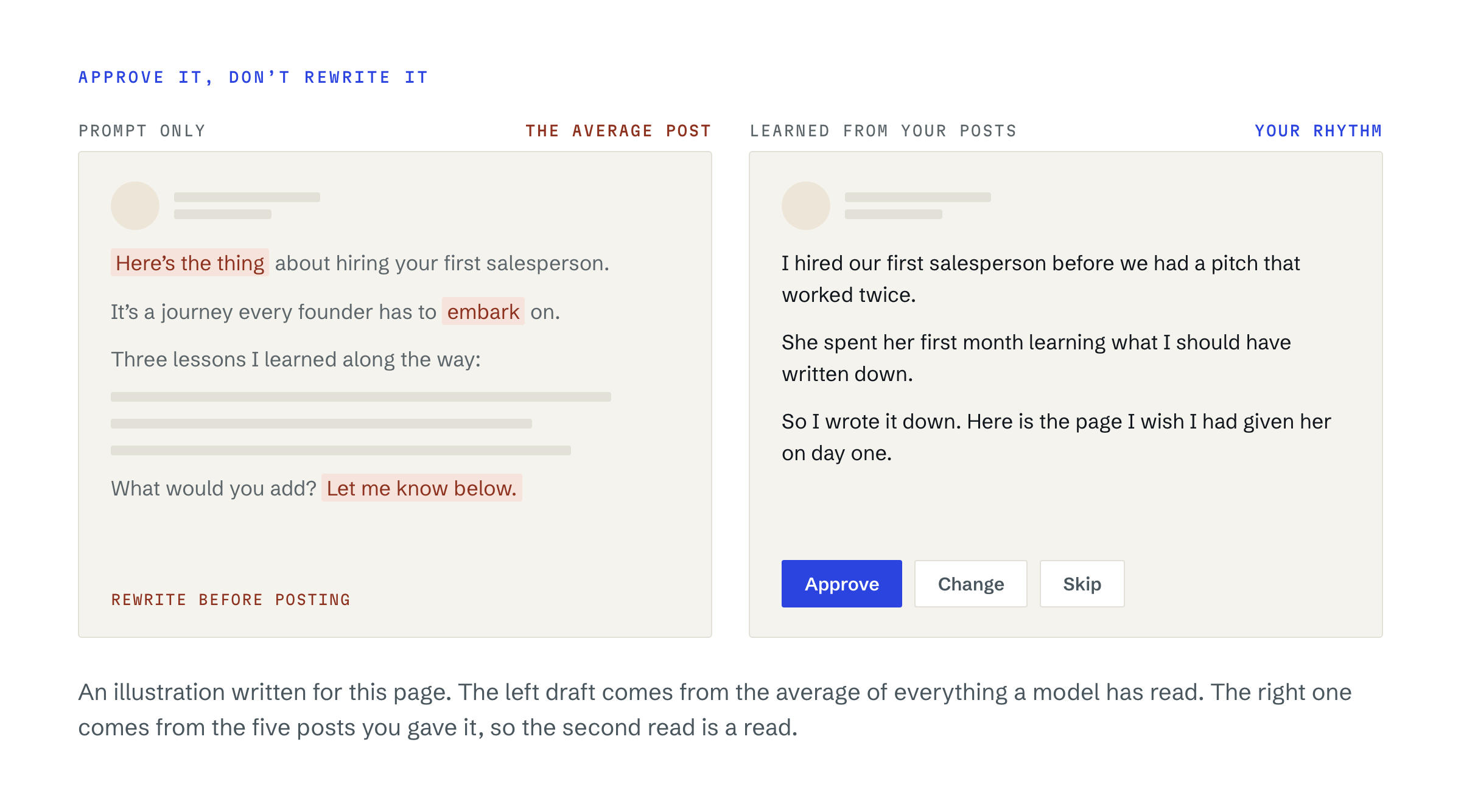
In GoReach you paste up to five posts you have published. Five is the limit on every plan, because past five, more examples stop making a difference. Variety helps more than volume, so one story, one opinion and one practical post teach more than five of the same kind. From those it learns your rhythm, your sentence length and how you open and close, and every draft is written in that voice.
On Pro you can keep up to twenty voices. That sounds like a lot until you notice that your company announcements and your personal stories are meant to sound different.
If you have nothing to paste yet, you can choose a GoReach voice instead. There are five, each written from three sample posts, and Story is the one GoReach uses when no voice is chosen.
Facts are part of your voice
A post can have exactly the right rhythm and still sound fake, because it describes something that never happened. I think an invented anecdote is the worst failure in AI-written posts. It reads smoothly, it is specific, and it is untrue, which becomes your problem the first time a client asks about it.
So on Autopilot, posts are written only from confirmed facts, each quoted from its source. An editor pass then checks every draft for vague claims, tone and invented anecdotes before you see it. A draft that states a number found nowhere in your facts is revised. Where a post needs a story only you have, you get one short question that week instead of a guess.
That last part matters more than it sounds. The best material in a founder's posts is almost always something that happened that week, and no model can know it unless it asks.
How to make AI LinkedIn posts sound human
If you are editing AI drafts yourself, this is the routine I would use. It takes a few minutes a post once you know what to look for.
- Delete the first line and read what is left. AI openers are usually throat clearing. The real first line is often the second one.
- Hunt for the flip. One idea set up only to be swapped for another is the most reliable single tell of machine-written copy. Say the second idea plainly and drop the first.
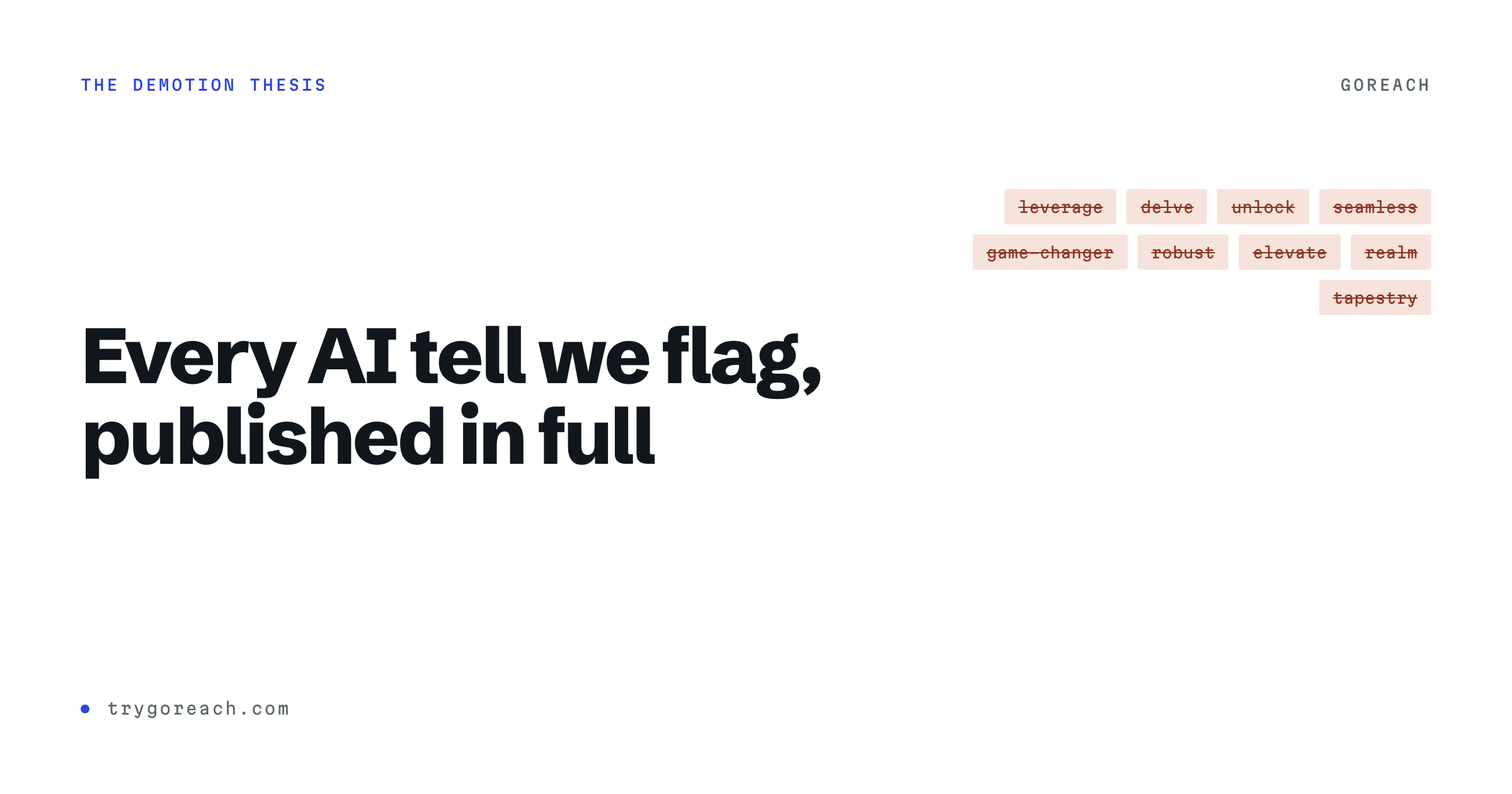
- Cut the stock vocabulary. The grand verbs nobody says out loud, and the throat-clearing lines that announce a point instead of making it, mark a post before anyone reads the argument.
- Replace every general claim with something that happened. A name, a number, a date, a thing a customer said.
- Remove the long dashes and the closing question. Both are habits of the average post, and a reader has seen them a thousand times.
We publish the full list of tells our checker flags: 24 words, 10 phrases and 30 opening formulas, plus the flip in every form it takes.
GoReach runs this check for you on every draft, using the same list the public grader uses, and the writer is held to the same rules, so it does not produce what its own grader would flag. Each draft also gets a reach grade with one-click fixes for the things that most often stop a post travelling, such as a link in the body or a best line buried below the fold.
Why we do not score how much a draft sounds like you
You might expect a "voice match" percentage. We do not show one. We looked for a measure that could reliably tell one author from another and did not find one, so we do not pretend.
You are the judge, which is why every post waits for your approval. Read it once. If it sounds like you and every fact is right, approve it. If not, ask for a change in your own words, typed or as a voice note, and the revised post comes back.
Written in your voice, published within LinkedIn's rules
A post that sounds like you is half the job. The other half is getting it out without putting your account at risk.
GoReach publishes through LinkedIn's official API, with the permission you grant on LinkedIn's consent screen. It never logs in as you. It does no scraping, and it sends no automated likes, comments, connection requests or DMs. The first comment is handed to you to paste. It is built to stay within LinkedIn's rules, which makes it in my view the lowest-risk way to automate your LinkedIn, though no tool can promise how LinkedIn treats an account. If you are weighing it against browser-based tools, read a safe alternative to LinkedIn automation tools.
There are two ways to use it, and both are on the pricing page:
- Pro, $49 a month or $490 a year, if you want to keep writing yourself and get the hour back: drafts in your voice, the reach grade with fixes, a first comment and an image card, and publishing and scheduling through LinkedIn's official API.
- Autopilot, $199 a month or $1,990 a year, if you want the posts done: research on your market, a strategy and a month plan, and every post written in your voice for you to approve in the app or on WhatsApp.
Both are in US dollars. There is no free plan and no free trial; ask within 14 days of your first payment and we refund what we received. Payment processing fees are not returned. To see what the checker catches first, paste an AI draft you decided not to post into the free grader. And if you are deciding between this and a general assistant, we wrote up GoReach compared with ChatGPT, including when the assistant is the better pick.
Questions founders ask
How do I train AI on my writing style?
Give it real samples of your writing. A description of your tone is too vague to copy. In GoReach you paste up to five posts you have published, and every draft is written in the voice it learns from them. Pick posts you would still publish today: an old post in a voice you have since dropped teaches the old voice.
Will LinkedIn penalise posts written with AI?
I have seen no evidence that LinkedIn detects AI-written text and demotes it for that reason, and we do not claim it does. What costs a generic post is readers who skip it. A post that sounds like you avoids that.
Is an AI LinkedIn ghostwriter in my voice as good as a person?
A good human ghostwriter interviews you and finds the story, and that is hard to replace. An AI writer trained on your posts can match your voice, and on Autopilot it asks a short weekly question to get the story. Whichever you choose, you should still approve every post yourself.
Does GoReach post for me automatically?
It publishes only posts you approved, through LinkedIn's official API. It never logs in as you, never posts an unapproved draft, and never comments, likes or messages on your behalf.
What if I have never posted on LinkedIn?
Start with one of the five GoReach voices: Story, Founder, Playbook, Operator or Point of view, each written from three sample posts. Pick the one closest to how you talk, and once a few real posts are published, train your own voice on those.