The demotion thesis6 min read
Every AI tell we flag, published in full
The words, phrases, openers and constructions our grader flags, taken from the files the product runs, with what to write instead. Including the three things deliberately left off the list.
By Neeraj · Updated
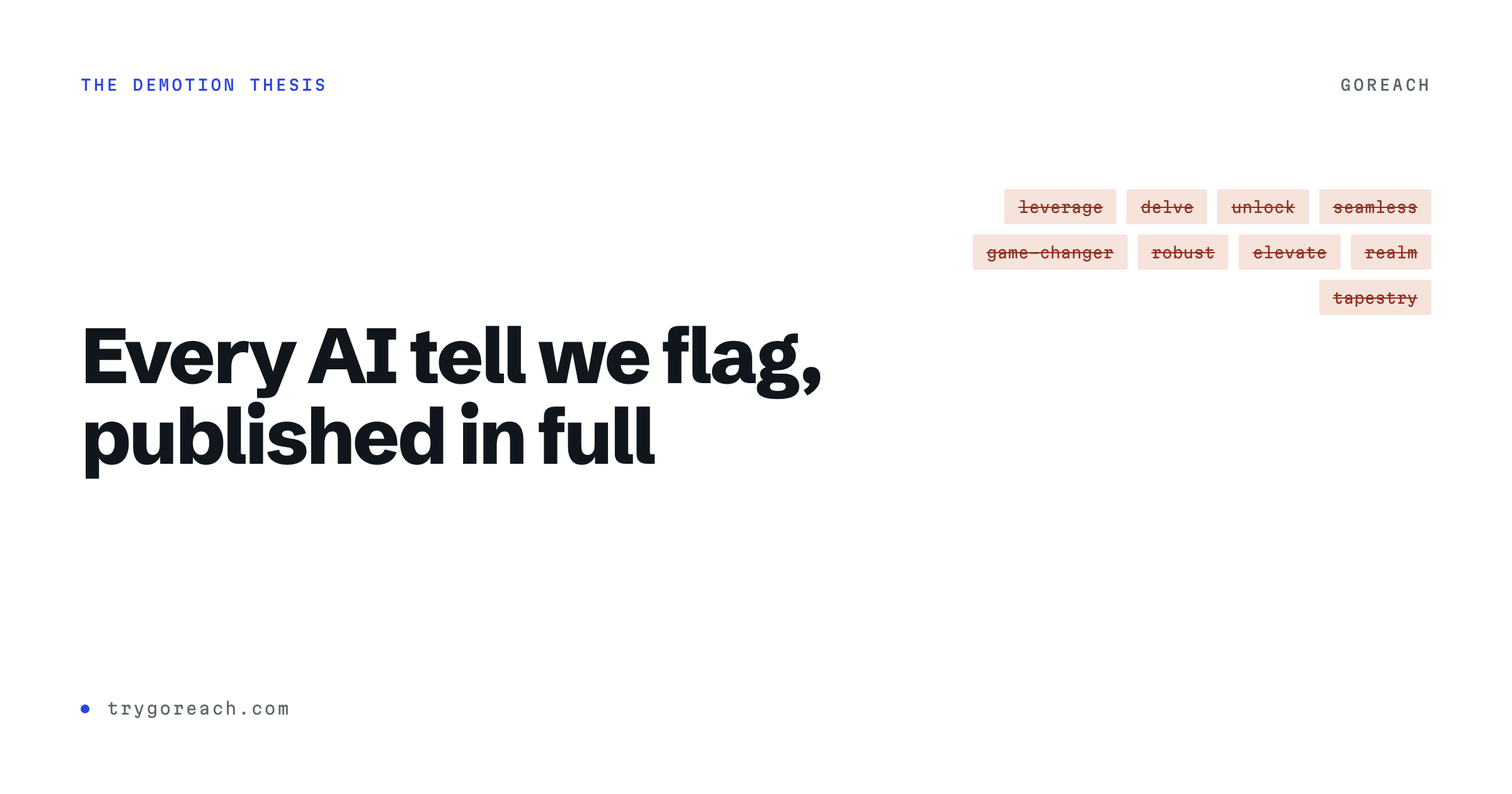
Every tool that claims to make writing sound human asks you to take its word for it. We would rather publish the list. Below is every word, phrase, opener and construction the GoReach grader flags, taken from the files the product actually runs, plus what to write instead.
A list you can check is worth more than an adjective you cannot. If you disagree with an entry, you can say so, which is the point of printing it.
Three layers, and only one of them is about vocabulary
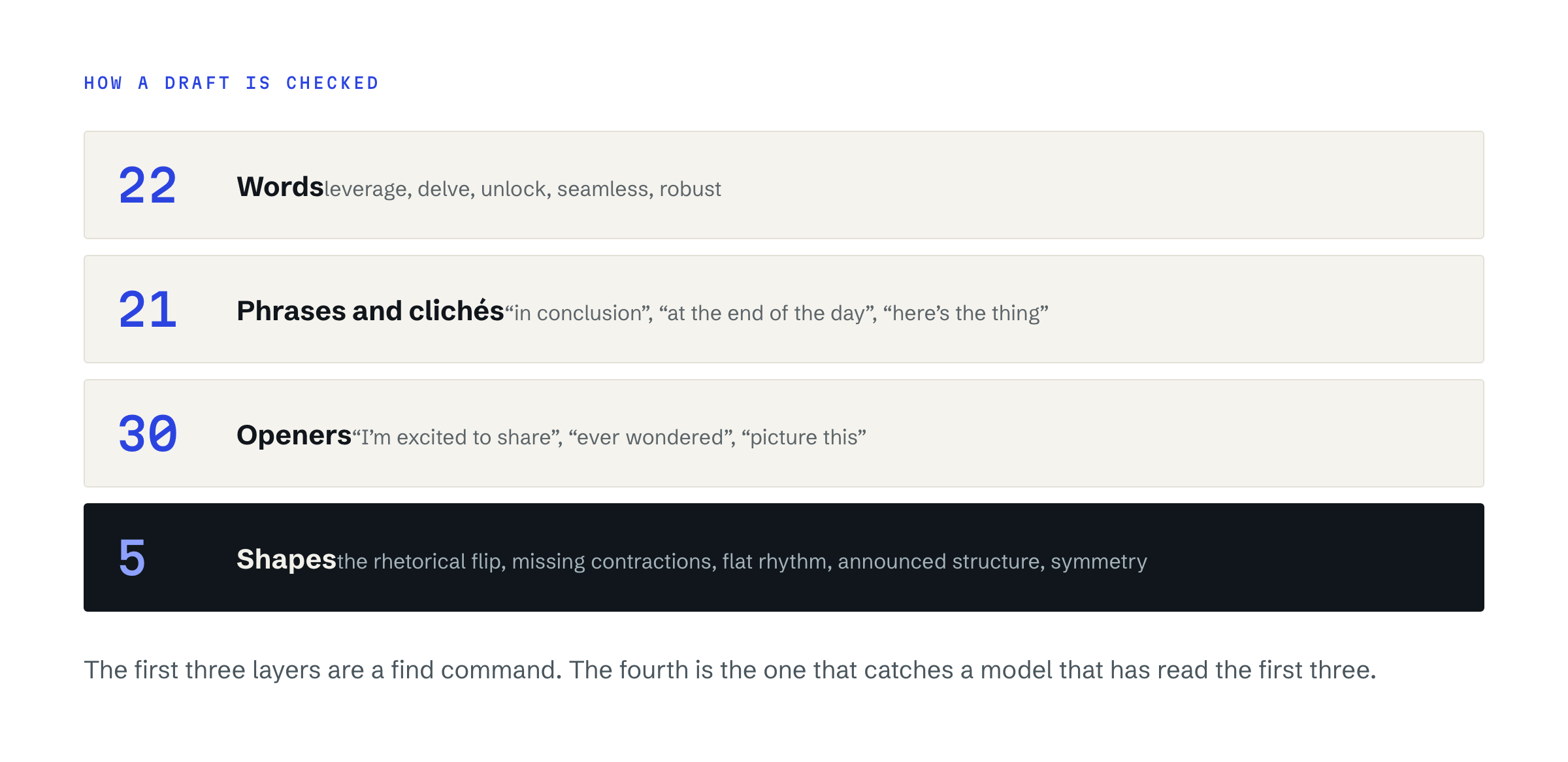
Detection happens in layers. The first two are lexical: single words and fixed phrases. The third is structural, and it is the one that catches well-written machine output, because a model that has been told to avoid "delve" will avoid it and still produce prose that reads wrong.
Layer one: the words
These are flagged wherever they appear. Most of them are ordinary English that became a tell through frequency: they are not wrong, they are simply what generated text reaches for.
leverage, utilize, unleash, unlock, deep dive, game-changer, revolutionary, synergy, robust, seamless, cutting-edge, delve, elevate, embark, navigate, tapestry, testament, realm, landscape of, foster, streamline, boost productivity
The replacement is almost always the plain verb. "Leverage our platform" is "use it". "Unlock growth" is "grow". "Streamline the process" is "cut two steps out of it", which is better because it tells the reader which two. Every one of these words is a place where a specific claim was available and a general one was chosen.
Layer two: the phrases
Fixed strings, flagged anywhere in the post:
"in today's digital landscape", "in today's fast-paced", "it is important to note", "in conclusion", "let's dive in", "when it comes to", "needle in a haystack", "the world of"
And a longer list of thought-leader clichés: "at the end of the day", "let that sink in", "harsh truth", "make no mistake", "now more than ever", "low-hanging fruit", "moving the needle", "double-edged sword", "elephant in the room", "here's the thing", "the truth is", "recipe for disaster", "speed over substance".
What these share is that they add length without adding information. "It is important to note that X" is "X". "At the end of the day, Y" is "Y". Delete the frame and the sentence survives, which is the test.
Layer three: the opener
The first line is checked separately and more strictly, because it is the most expensive real estate on LinkedIn. Only about 210 characters are visible before the post is truncated, so a cliché in the opener costs you the whole visible portion.
Thirty openers are flagged. The families are:
- Announcement warmers. "I'm excited to share", "thrilled to announce", "proud to share", "humbled to share", "happy to share", "honored to share", "without further ado".
- Rhetorical hooks. "Ever wondered", "have you ever", "imagine a world", "picture this".
- Throat-clearing. "I've been thinking", "I've been reflecting", "lately I've been", "let's talk about", "I wanted to share", "I have to say", "let's dive in".
- Date framing. Anything beginning "in today's".
Each one spends the visible portion of the post on the fact that a post is about to happen. The fix is to open on the thing itself. "We cut onboarding from five steps to two" needs no warm-up, and it survives the truncation intact.
Layer four: the shapes
This is the layer that matters, and it is where most of the engineering went.
The rhetorical flip
"This is not about the tool, it's about the habit." "We didn't build a feature, we built a philosophy." Five separate patterns catch this construction, including the version that spreads across two sentences, which the obvious single-clause check misses entirely.
The flip is appealing because it sounds like a conclusion. It usually is not one: the first half denies something nobody claimed, so the second half can arrive as a revelation. Write the second half on its own and see whether it still carries.
The detector is deliberately conservative here. "Doesn't reward talent. It rewards consistency." is not flagged, because both halves are concrete and the contrast is real. What gets flagged is the vague version, anchored on "about", "just", "merely" or "only". That distinction cost several iterations to get right, and it is the difference between a grader that helps and one that punishes good writing.
Engagement bait
"Comment YES below", "tag someone who needs this", "follow for more", "thoughts?", "what do you think?". Fourteen patterns. LinkedIn down-ranks these asks directly, so the cost is not only that the line reads badly.
Note the restraint: a specific question tied to the post is not flagged. "Has anyone run this on a services business?" is a real question. "Thoughts?" is a request for engagement with no content, and those are the ones caught, by exact phrasing rather than by a rule about question marks.
The long dash
Six glyphs are counted as one class: the em dash, the en dash, the horizontal bar, the figure dash, and the two-em and three-em dashes. The minus sign is deliberately excluded, so numeric text is left alone.
Long dashes are the single most reported AI tell, and the grader used to count only the em dash, which let the others through. A comma, a full stop, a colon or the word "to" replaces one in every case we have found.
Shape tells with no vocabulary at all
Four more, which no word list can reach: missing contractions held consistently across a whole post, uniform sentence length, announced structure (a line that promises the next line instead of being it), and symmetry (three points of equal weight closing on a summary). These are described with the measurements in what "sounds like AI" means mechanically.
What is deliberately not on the list
Three things, each left out for a reason.
Em dash counts below the threshold. One dash in a long post is a writing choice. Density is what reads as machine-written.
Borderline idioms. The cliché list is described in its own source comment as "conservative on purpose: borderline human idioms are excluded so genuine writing isn't punished". A grader that flags everything trains you to ignore it.
Anything about topic or opinion. The grader has no view on what you write about. It checks whether the writing will travel, which is a separate question from whether it is right.
How to use this
Run a draft through the lists in order. The words and phrases take two minutes with a find command. The openers take one look at your first line. The shapes take a read-aloud, which is the step that does the most work and the one people skip.
If you would rather have it done for you, the public grader runs every check above on a pasted draft and tells you which fired, with no account. The list on this page is the same list it uses.