The demotion thesis6 min read
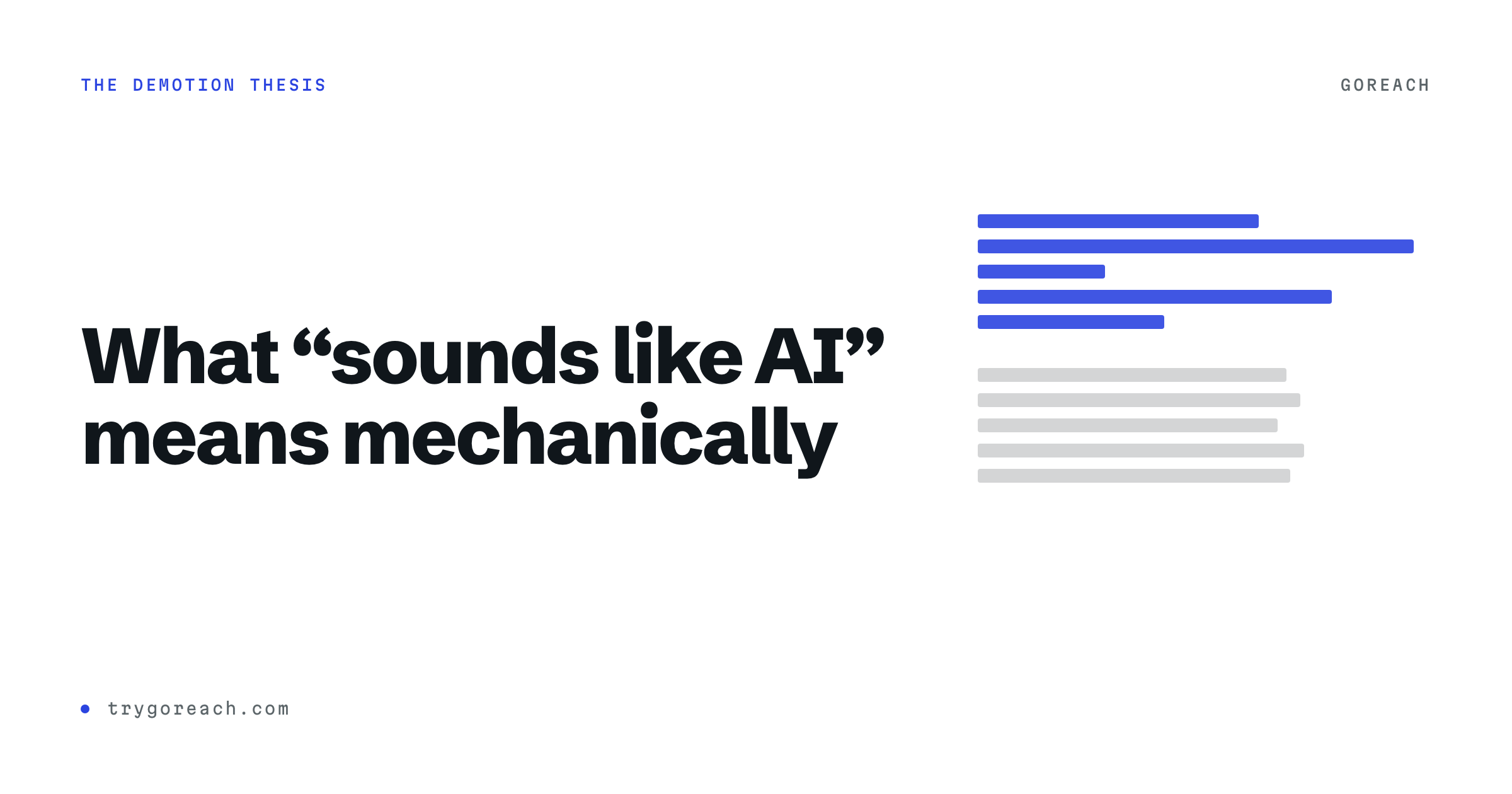
What "sounds like AI" means mechanically
The tells are not vocabulary. We built a vocabulary detector, ran our own writing through it, and it passed. Here are the four structural signals it missed, with the measurements and how to check a draft yourself.
By Neeraj · Updated
Everybody can tell when a LinkedIn post was written by a machine, and almost nobody can say why. "It just reads like AI" is the usual answer, which is useless to anyone trying to fix a draft.
It is also wrong that the tells are vocabulary. We built a detector on a vocabulary list, ran our own writing through it, and it passed. A human reading the same paragraphs had already called them machine-made.
What the vocabulary layer catches, and what it misses
Word-level detection is real but shallow. It catches stock openers, a list of words that have become shorthand for generated text, and the rhetorical flip where a sentence denies one thing in order to assert another. Those are worth removing. They are also the easiest tells to avoid, which means the better-written machine output no longer contains any of them.
The draft that passed our detector had none of them and still read wrong. The reasons were all structural.
Four mechanical tells, in order of how loudly they give it away
Missing contractions. "I do not think" instead of "I don't think", held consistently across a whole post. No person writes this way for 200 words. It is the loudest signal and it survives every vocabulary filter, because every individual word is ordinary.
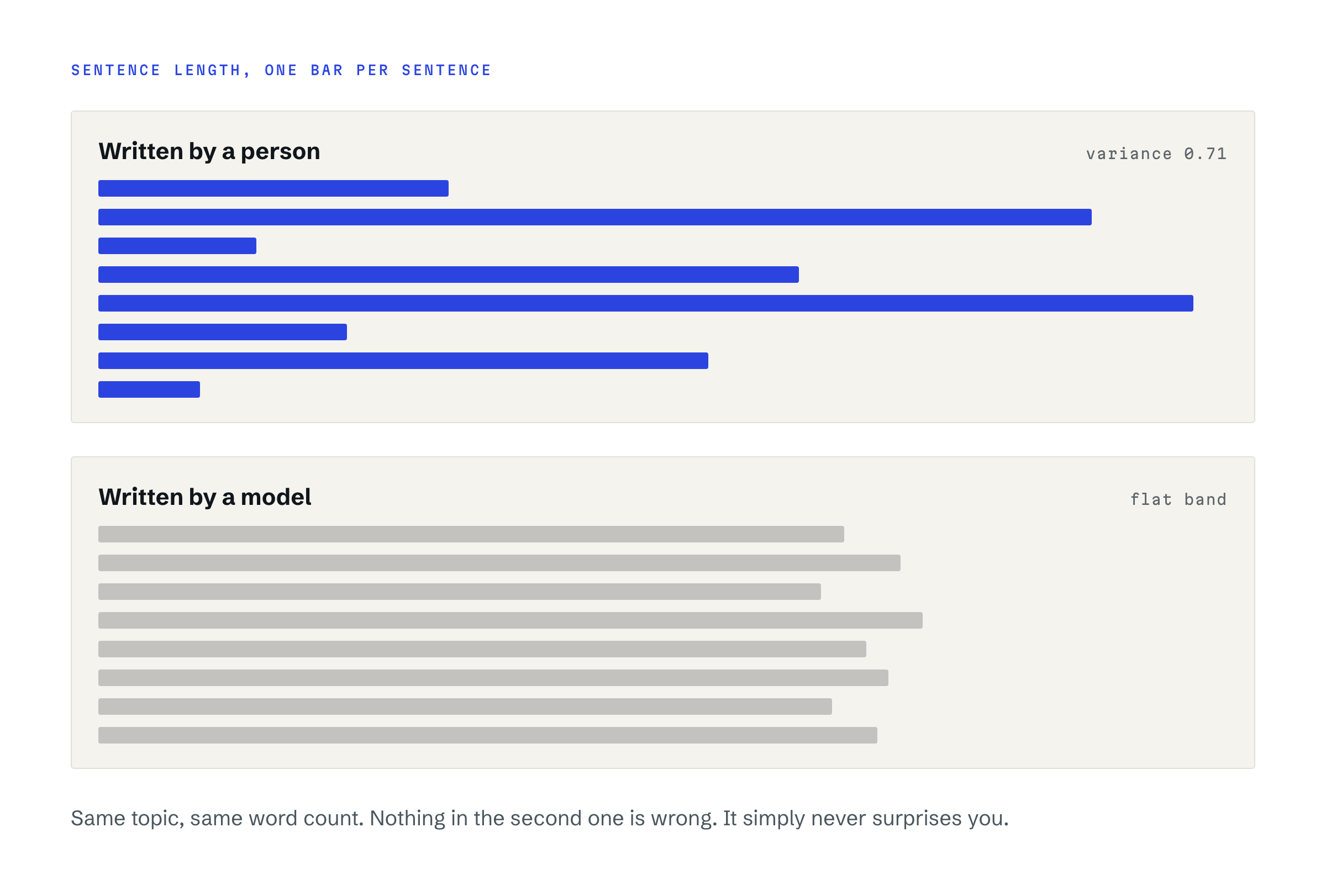
Uniform sentence length. Human writing lurches. A nine-word sentence lands next to a thirty-word one. Generated prose settles into a narrow band and stays there. This is measurable: take the coefficient of variation of sentence lengths across the post. Our human-edited draft came out at 0.71. The version a reader flagged as machine-written was substantially flatter at the same word count.
Announced structure. "Two things that probably are." "Here is what makes this one special." A line that promises content instead of delivering it. People write the thing; models introduce it first.
Symmetry. Three points, each with one piece of evidence, each about the same length, closing on a summary. Far too tidy. Real arguments are lopsided, because the author cared more about one part than the others.
Why this matters more than it used to
LinkedIn's distribution rests on dwell time, which is why length and reading rhythm are ranking inputs rather than style preferences. Two numbers follow from that and both are actionable. The platform truncates a post at roughly 210 characters, and line breaks count toward the total. And posts that hold attention tend to sit between 154 and 232 words: short enough to finish, long enough to accumulate the dwell that distribution is scored on.
A post can clear every vocabulary check, land inside the word band, and still fail, because the rhythm tells the reader what produced it before the argument does.
The part that is harder to accept
Asking a model not to sound like a model does not work reliably. We measured this. A rule stating that writing samples were there for form only and were never a source of facts lost to a competing instruction elsewhere in the same prompt: the generator was reproducing 73 five-word runs per post straight out of its own samples. Rewording the instruction changed nothing. Removing the nearest sample in code, before the prompt was assembled, took it to 1.3.
That is the general shape of it. A rule that competes with another rule inside one context window loses unpredictably. If something has to hold, it needs a deterministic check running after generation, not a politely worded request going in.
How to measure it rather than guess
Three of the four tells can be counted, which means you can check a draft without trusting your ear.
- Contractions. Search the draft for an apostrophe. Zero across 200 words is the single strongest signal, and it is a two-minute fix.
- Sentence length variance. Split on full stops, count the words in each sentence, and look at your shortest against your longest. If the gap is under about ten words, the rhythm is flat. The coefficient of variation is the formal version of the same check, and our human-edited draft came out at 0.71.
- Announced structure. Read only your first sentences. Any of them that promise rather than deliver can be deleted outright, and the paragraph underneath almost always reads better as the opener.
Symmetry is the one you have to judge by eye. Look at the length of each section. If they are close, you have written an outline rather than an argument, because you cared about all four points equally, which nobody does.
Why this is getting harder, not easier
The vocabulary tells are disappearing. Every model release writes cleaner prose than the last, and every writer who has read one of these lists avoids the obvious words. What does not change is the rhythm, because the rhythm comes from how the text is produced rather than from which words were chosen.
That has a practical consequence. Any check that works on a word list has a shelf life measured in months. The structural checks have held since we started measuring, which is why our grader treats them as the serious layer and the vocabulary list as housekeeping. The full list of what we flag, words and shapes both, is published in the tells we flag.
What to do with a draft you have in front of you
Read it aloud. Every phrase you would not say, change.
Count your contractions. If there are none, that is the fix with the highest return.
Look at your shortest and longest sentence. If they are close in length, break one up.
Delete any line that introduces the next line.
Find the paragraph you care about most and make it longer than the others.
None of that requires a tool. It does require reading your own writing as a stranger would, which is the part people skip.