Reach readiness6 min read
The reach checklist in full: thirteen checks, three bands
A score you cannot interrogate is a vanity metric, so here is every check GoReach runs against a LinkedIn draft: what each one catches, what it costs, and what the grade deliberately refuses to tell you.
By Neeraj · Updated
A score you cannot interrogate is a vanity metric. So here is the whole checklist GoReach runs against a LinkedIn draft: every check, what it catches, what it costs, and what to do about it. Thirteen checks in three bands, plus one verdict that overrides the rest.
None of it predicts virality. Nothing can. What it answers is narrower and more useful: is there anything in this draft that will stop it travelling.
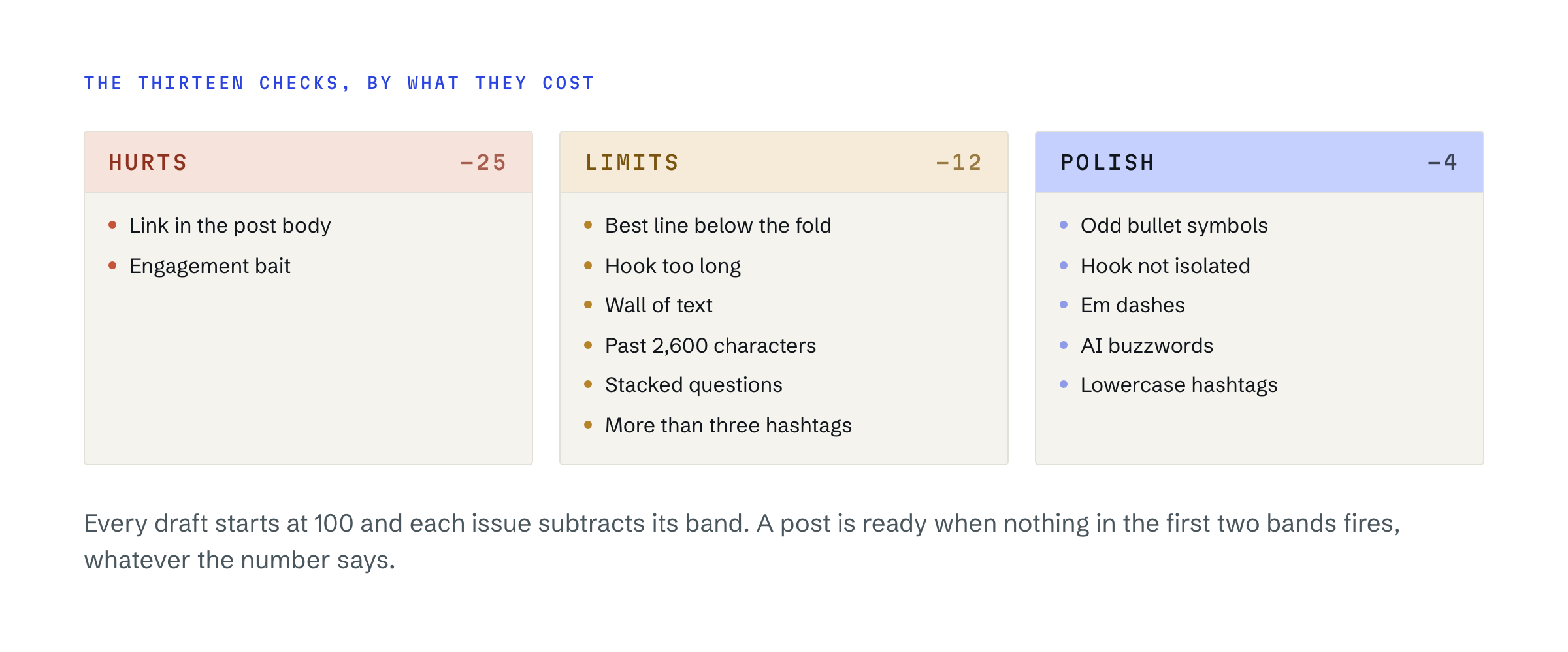
Band one: hurts (25 points each)
Two checks, both of which cause a measurable drop in distribution rather than a drop in readability.
A link in the post body. Reported reductions in reach for an in-body link run from 20 to 60 percent. The fix is to move it to the first comment, which is a normal thing to do and not a trick: the link is still one tap away and the post keeps its reach. This is the single most common fixable mistake we see.
Engagement bait. "Comment YES below", "tag a friend", "follow for more". LinkedIn down-ranks these asks explicitly. A real question tied to the post is fine and is not flagged; the fourteen patterns are listed in the tells we flag.
Band two: limits (12 points each)
Six checks. None of them gets a post suppressed. Each one reduces how far it gets.
The best line is below the fold. LinkedIn truncates at about 210 characters, so a strong line in paragraph three is invisible to everyone who does not tap "see more". The fix lifts it to the top. This check is the reason we built a separate detector for where a post's strongest sentence actually sits, rather than assuming it is the first one.
The hook is too long. A first line that runs past the visible portion loses the scroll before the reader has a reason to stay.
Wall of text. One dense block is hard to read on a phone, and dwell time is a ranking input, so a block that people bounce off costs reach as well as readers.
Too long overall. Past roughly 2,500 characters, completion rate falls, and LinkedIn's hard cap is 3,000. We flag at 2,600. There is no minimum: short posts are fine, and we deliberately never tell you a post is too short.
Stacked questions at the end. Three questions in a row read as an engagement checklist rather than curiosity.
More than three hashtags. Keep the three most relevant. Beyond that they stop helping and can suppress.
Band three: polish (4 points each)
Five checks that cost almost nothing individually and add up to a post that reads amateur.
- Odd bullet symbols. Asterisks and
[ ]render as stray characters on LinkedIn, because it has no markdown. - The hook is not isolated. Give the opening line a blank line under it so it stands alone above the fold.
- Em dash density. The strongest single AI tell. Swap for a comma or a full stop.
- AI buzzwords. The word and phrase lists, published in full in the piece above.
- Lowercase hashtags.
#LikeThisreads as deliberate and is also more accessible: screen readers use the capitals to find word boundaries.
The verdict that overrides the bands
If a draft carries enough structural tells to read as machine-written, the grade says so directly instead of listing eight separate style issues. One line, one reason: the post will not travel, and here is the construction doing it.
That was a deliberate decision. Listing every detector turns a verdict into a lint report, and a lint report is something you close. What a writer needs is the single fact plus the one fix, which is why the grade carries an action rather than a diagnosis.
How the number is built
The arithmetic is deliberately dull. Every draft starts at 100. Each issue found subtracts its band's penalty: 25 for a hurts, 12 for a limits, 4 for a polish. The floor is zero. There is no weighting by post length, no curve, and no bonus for anything.
Readiness is a separate answer to a separate question. A post is "ready to post" when it carries no issue in the first two bands, whatever the number says. So a draft with three polish nudges scores 88 and is ready; a draft with one link in the body scores 75 and is not. The number tells you how much is left to tidy. The verdict tells you whether to publish.
That split exists because a single number invites the wrong behaviour. Chasing 100 means removing your hashtags and your questions, which is not the same thing as writing a post worth reading.
Why thirteen, and not fifty
Every check on this list had to clear two bars: it has to be deterministic, and it has to carry a fix the writer can act on in under a minute.
Deterministic rules out anything that needs a model to judge it, which is most of what a human editor would say about a draft. We would rather have thirteen checks that give the same answer every time than forty that depend on which way a language model felt that morning. The one check that does use a model, finding where a post's strongest line actually sits, runs only on graded drafts inside the product, and its output is a suggestion rather than a verdict.
Actionable rules out the rest. "Your hook is weak" is true of most drafts and helps nobody. "Your strongest line is at character 740 and the cut is at 210" is the same observation with a fix attached, and the fix is one keyboard shortcut in the editor.
What the checklist will not tell you
It will not predict how many impressions you will get, because nobody can. It will not tell you whether your point is any good. It will not score your topic, your industry or your follower count. And it will never give you a number that only goes up as you add more of something, which is how engagement-maximising tools end up encouraging exactly the posts the platform demotes.
The grade is a readiness verdict, not a prediction. A post can clear every check and land flat because the idea was thin. The checklist stops the opposite failure, which is far more common: a good idea discarded because of a link in the wrong place.
Run it on something you have already posted
The most useful first run is on a post that underperformed. Paste it into the public grader, with no account, and see which checks fire. Most people find one band-one issue they had been repeating for months.
The checks here are the same ones that run inside the product, on every draft, before you publish. They are also the reason the generator and the grader agree: a draft written by GoReach is written against this list, so the tool cannot produce something its own grader would reject.